


With its houses perched on limestone cliffs, Bonifacio is probably the most impressive town in Corsica, and for us it was the highlight of the entire road trip, ahead of Calvi and the beaches in the northwest of the island. Here we show you everything you need to know about the citadel, the King of Aragon’s Staircase, parking, boat tours and the crossing to Sardinia.
We visited Bonifacio in June 2026 and came back in October to take the ferry from here to Sardinia.
Last updated: October 2026.
Things to Do in Bonifacio: Our Highlights
Citadel & Old Town of Bonifacio
Bonifacio sits on a narrow limestone plateau about 1 mile (1.5 km) long at the southern tip of Corsica, and its cliffs rise more than 330 feet (100 m). The citadel’s defensive walls run around the entire plateau. That means the citadel actually takes up the whole area of the old town.

The Genoese turned the town into a fortress in the Middle Ages. The old Genoese gate leads you into the upper town with its narrow, tall alleys. It is a maze of medieval lanes and old churches where you can wander to your heart’s content. We walked through the old town on foot in June 2026, and that is also the best way to explore Bonifacio: from mid-May to the end of September, the upper town and the quays of the marina are pedestrian-only anyway.
Worth seeing in the old town are the Bastion de l’Étendard, with a small museum on the town’s history, and the church of Sainte-Marie-Majeure, whose covered loggia once served as a meeting place for town councilors. A walk along the citadel walls offers constantly changing views of the sea and the coast of Sardinia opposite, which is easy to make out on clear days.
The only part of Bonifacio that historically did not belong to the citadel is the harbor district at the foot of the cliffs.


The Natural Harbor of Bonifacio
The natural harbor of Bonifacio is considered one of the most spectacular and best-protected harbors in the entire Mediterranean. Like a narrow fjord, it stretches almost 1 mile (1.5 km) deep into the white limestone cliffs.
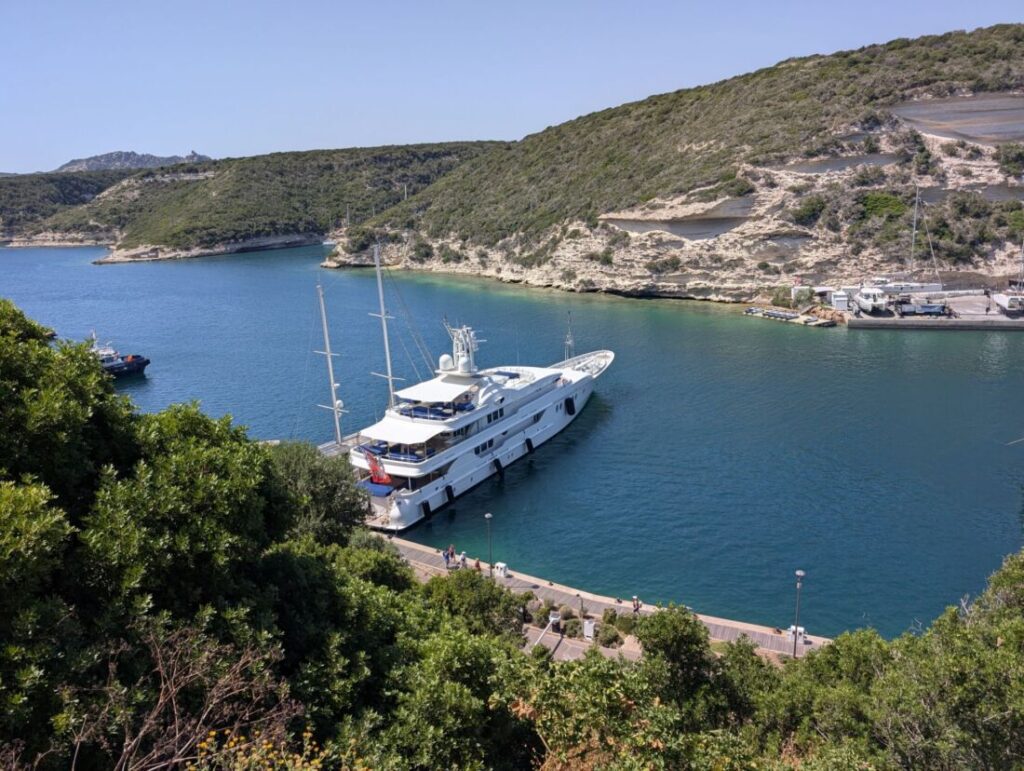
Along the promenade you will find fish restaurants, cafés, ice cream shops and souvenir stores, and in summer large yachts moor at the marina. The boats for excursions (for example to the Lavezzi Islands) and the ferry to Sardinia also depart from down here.
King of Aragon’s Staircase
The King of Aragon’s Staircase descends 187 steps cut into the rock, from the upper town almost down to sea level. According to legend, the troops of the Aragonese king Alfonso V carved it into the limestone in a single night during the siege of Bonifacio in 1420, in order to cut off the town’s water supply.
This is not historically proven, and the staircase more likely served as access to a well at the foot of the cliff. The descent is steep but doable, and with photo stops you should allow about 20 to 30 minutes for the round trip. Tickets cost about €5 per person and are sold on site. Prices vary by source, though (the tourist office lists “from €2”). The number of steps is also given as either 187 or 189. The staircase is only open seasonally, from about February to mid-November according to Visit Corsica, and the cave at the bottom is closed to visitors.
Tip: Go down early in the morning or late in the afternoon. At midday you are completely exposed to the blazing sun on the steps.
Walk Along the Cliffs
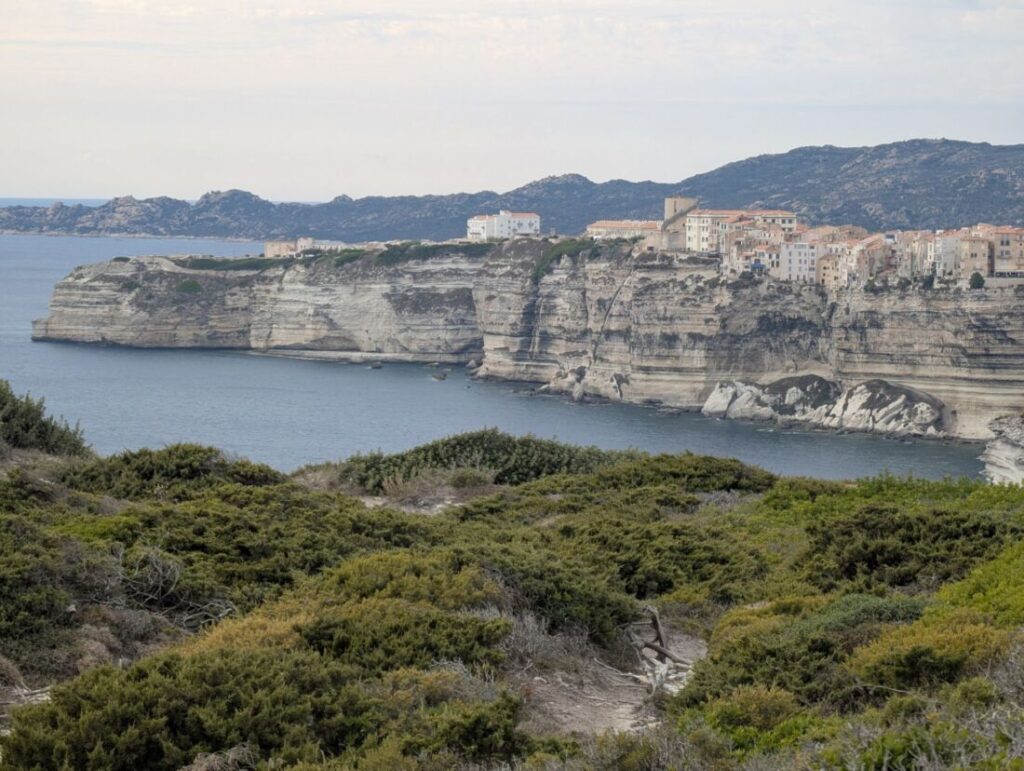
A spectacular trail starts right at the citadel and runs along the limestone cliffs. From here you get the best view of the iconic houses perched right on the edge of the cliff. We went to the viewpoint where you can see Bonifacio sitting on its cliffs, and the view is absolutely worth the short walk. You can set off directly from the old town (Google Maps) or park for free at the roadside a bit farther out and then walk toward the old town (Google Maps). Note that parking is very limited here.
Marine Cemetery (Cimetière Marin)
At the end of the peninsula, in the Bosco district, lies the Cimetière Marin. White family chapels and graves stand close together like a small town, facing the sea, and the cemetery is considered one of the most picturesque in the Mediterranean. You can reach it on foot from the upper town or by car, and one of the town’s parking lots is right next to it. We have not been there ourselves. When you visit, keep in mind that it is a cemetery where families visit their loved ones. You can read below why the peninsula was left undeveloped at this spot.
Day Trips from Bonifacio
Boat Tour to the Sea Caves and Cliffs
Several operators run boat tours along the cliffs from the natural harbor (Google Maps) at the foot of the upper town. The short cruise takes about an hour and costs from around €18.50 per adult. It passes the La Madonetta lighthouse and enters the Sdragonato cave, whose open rock ceiling is said to resemble the outline of Corsica when seen from above.
If you have more time, book one of the roughly two-hour tours through the Bouches de Bonifacio nature reserve, which include a stop for swimming and snorkeling.
Tip: The boats only enter the cave in calm seas. Ask directly at the harbor whether the entrance is possible on the day you want to go.
Lavezzi Islands Boat Trip
The Lavezzi Islands lie southeast of Bonifacio. This nature reserve has turquoise bays between oddly shaped granite rocks. Larger tours often combine the Lavezzi Islands with additional swimming stops.
For a pure boat ride without going ashore, allow about an hour, and correspondingly more with time on the island. Half-day and full-day tours cost roughly €55 to €110 per adult, depending on the operator and what is included.
You can book a boat tour with snorkeling in the marine park through GetYourGuide*.
Hike to Capo Pertusato
From the end of the peninsula at the citadel, a trail leads to the Pertusato lighthouse. Along the way you have constant open views of the cliffs and the town in its spectacular setting. Behind the Fanale di Pertusatu lighthouse (Google Maps), a narrower path branches off and takes you down a steep descent of about 15 minutes to Saint-Antoine beach, a rugged bay landscape with a large, open sea cave.
The trail along the cliffs has no protective barriers in several places, so be especially careful with children. You can find a route including a GPX track, for example, on ich-geh-wandern.de.
Tip: Bring plenty of water for the hike. There is nowhere to buy anything along the entire trail.
Beaches Near Bonifacio
There is no real beach in the town itself, and the nicest swimming spots are in the surrounding area. The small Plage du Petit Sperone is only about 10 to 15 minutes away by car, but it is very busy in summer. We saw it on our paddle trip from Piantarella. You can read more about it in our article on the best places to visit in Corsica, where we also describe Rondinara beach between Bonifacio and Porto-Vecchio.
You can only reach Saint-Antoine beach at the foot of Capo Pertusato on foot: either via the cliff hike or by driving to the semaphore and walking another 25 minutes or so from there. Parking is limited in high season. We have not been there ourselves.
Why Isn’t the Tip of Bonifacio’s Peninsula Built Up?
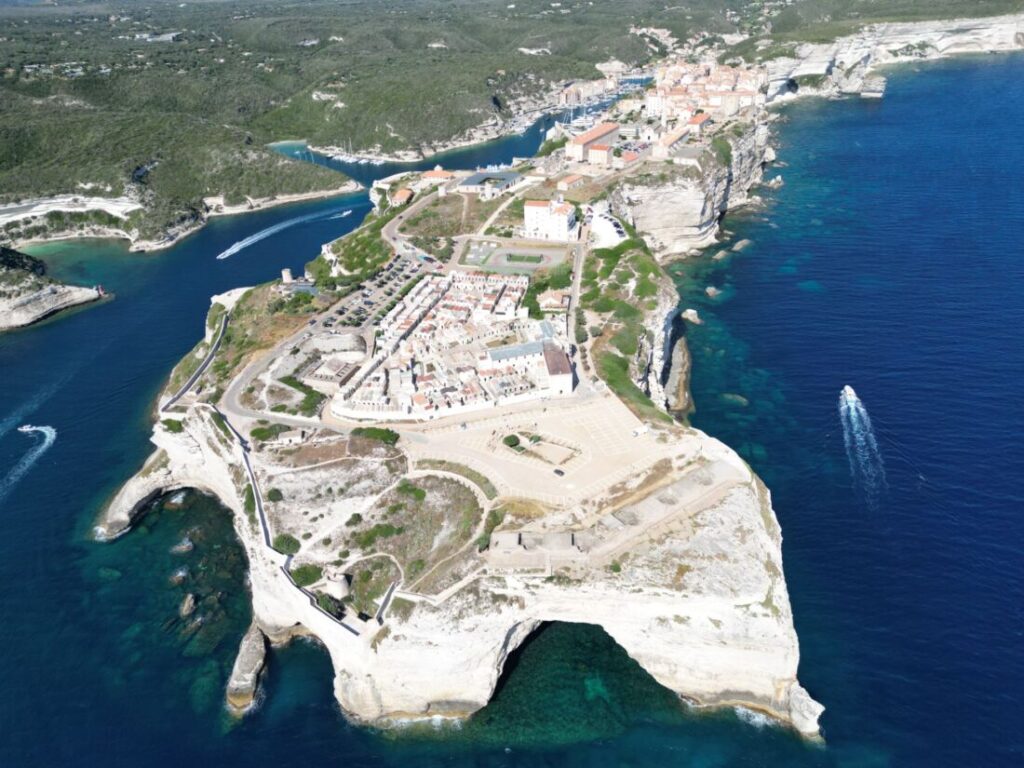
If you look at drone photos of Bonifacio, you will notice that the iconic buildings right on the steep cliff do not extend to the western tip of the peninsula. But why is that?
The fact that the residential buildings of the historic old town (Haute Ville) do not reach the far western end of the limestone peninsula of Bonifacio comes down to a combination of strategic, climatic and practical reasons. The tip of the peninsula, known as the Plateau du Bosco, was historically always kept free for other purposes.
1. Military defense and a clear field of fire
For centuries Bonifacio was a heavily contested fortress town and a military outpost of the Genoese. The far end of the peninsula was the most important strategic lookout: from here, both the narrow entrance to the natural harbor and the strait between Corsica and Sardinia could be perfectly monitored. To fire cannons, build fortifications and spot the enemy early, the military needed a completely clear field of fire and view. Houses would have literally stood in the way of the defense.
2. Protection from extreme winds
The tip of the peninsula juts out into the sea with no shelter and is mercilessly exposed to the region’s extreme winds (such as the Mistral and the Libeccio). Living out there would have been extremely uncomfortable in the long run and at times even dangerous. The townspeople therefore built their houses farther back, tightly packed and rising high, and surrounded them with tall walls. This created a self-contained, wind-protected microclimate in the narrow alleys that would not have been possible on the open Plateau du Bosco.
3. Space for vital infrastructure
Because Bonifacio often had to withstand sieges lasting months, the town needed space inside its defensive ring to feed itself. Windmills were therefore built on the plateau at the end of the peninsula (their ruins partly still stand today). They were essential for grinding grain during a blockade. Houses could not be allowed to block the wind the mills depended on.
4. The origin of the “City of the Dead”
In the 19th century, new hygiene laws required cemeteries to be moved out of the dense residential core of towns. The undeveloped Plateau du Bosco was an ideal spot. That is how the now famous marine cemetery (Cimetière Marin) came to be built there.
Today the end of the peninsula is therefore anything but empty. It is in a way the mirror image of the old town: where the dense city of the living ends, hundreds of white mausoleums lined up tightly side by side form a small “city of the dead”.
Practical Tips for Bonifacio
Where to Stay in Bonifacio (Hotels & Camping)
There are a few campgrounds within walking distance of the old town, but unfortunately they are right on the road (for example Camping L’Araguina). We would recommend choosing a quiet campground a bit farther out and then cycling or driving your camper into town for sightseeing.
There are plenty of hotels in the old town. You can find good prices on Booking.com*
During our stay we camped at Camping Rondinara, which lies on one of the most beautiful bays in Corsica between Bonifacio and Porto-Vecchio. You can find more about it and our other favorite campgrounds in our article on camping in Corsica, where you will also learn why wild camping and free camping are not a good option on the island.
Ferry from Bonifacio to Sardinia
Ferries to Santa Teresa Gallura in Sardinia leave Bonifacio several times a day, and the crossing takes about 50 minutes. We took that crossing ourselves in October 2026. Depending on the operator, season and how far ahead you book, tickets start at around €32 per person, and they cost considerably more in high season and if you bring a vehicle.
A day trip or a short detour to Sardinia fits easily into a Corsica road trip. You can find more about our whole route in our article on the 2-week Corsica road trip.
Parking in Bonifacio
There is no free parking in Bonifacio, and the municipal parking lots charge fees from the start of the spring school break until the end of the All Saints’ Day break. There are five parking lots for visitors in the center: at the harbor (Parking minute, P1 and P2), on the way up to the upper town (P3) and at the end of the peninsula near the marine cemetery (P5). Here you usually pay around €20 for the day, depending on the parking lot.
The Valli parking lot at the roundabout just before the center is cheaper and better suited to larger vehicles. A day costs around €10 there, but motorhomes may only park there between 8 am and 10 pm. According to Visit Corsica, a free shuttle bus runs from there to the marina every 30 minutes between 10 am and 6 pm from June 16 to September 11. The Monte Leone parking lot, on the other hand, is reserved for tour buses.
Tip: In high season, arrive as early in the morning as possible. The central parking lots are often already full from late morning.


Frequently Asked Questions About Bonifacio
How much time do I need in Bonifacio?
The old town is well worth seeing but not very big, so 1 to 2 days are plenty.
How many steps does the King of Aragon’s Staircase have?
The staircase has 187 steps cut into the rock (some sources count 189) and leads from the upper town almost down to sea level.
How high are the cliffs of Bonifacio?
According to the town’s official tourism site, the cliffs are more than 330 feet (100 m) high.
How long is the ferry from Bonifacio to Sardinia?
The crossing to Santa Teresa Gallura takes about 50 minutes, and tickets start at around €32 depending on the season. For 2 people with a car or camper, expect to pay around €150 to €200 for a one-way crossing.
How much does a boat tour from Bonifacio cost?
The short cruise to the caves takes about an hour and costs from around €18.50. Half-day and full-day tours to the Lavezzi Islands cost roughly €55 to €110 per adult, depending on the operator.
Is there free parking in Bonifacio?
No, the municipal parking lots charge fees in season. The cheapest is the Valli parking lot on the edge of town at around €10 per day, with a free shuttle to the marina in summer.
Is the old town of Bonifacio pedestrian-only?
From mid-May to the end of September, the upper town and the quays of the marina are pedestrian-only, so you’ll need to leave your car in one of the parking lots.