


What rental car do you need for an Iceland road trip? Do you need a 4×4 or will a small car do? And what about insurance – what coverage is actually worth getting in Iceland?
We have all the answers – from our own experience as Iceland self-drive travellers. In June 2021 we spent four weeks driving Iceland with a Dacia Duster, covering the Ring Road and the Highlands. Here’s everything we learned about renting a car in Iceland.
The prices in Iceland are generally high – much higher than elsewhere in Europe – and rental cars are no exception. Getting the right car for your needs, at the best price, takes a bit of research.
It makes a big difference whether you’re planning to stick to the Ring Road and Golden Circle or venture into the Highlands on Iceland’s F-roads. Routes like Laki, Landmannalaugar and many highland tracks are only accessible in a 4×4.
For a full 14-day Iceland itinerary including the Highlands, check our travel guide:
Iceland Highland Itinerary | Perfect 14-Day Highlands & Highlights Road Trip
Last updated: June 2026
Do I Need a Rental Car in Iceland?
A rental car in Iceland is by far the best way to explore the island. Iceland is larger than most people expect – roughly the size of Bavaria and Baden-Württemberg combined – but has far fewer roads.
Driving the Ring Road all the way round takes about 15 hours without stops. Distances are significant and public transport outside Reykjavík is limited.

If you only have a few days, guided day tours or multi-day tours* from Reykjavík are a great alternative to renting a car.
The most flexible option is always your own Iceland rental car. A self-drive trip lets you set your own pace and choose exactly which highlights you visit. We booked through the Iceland specialist Northbound Iceland* – an Iceland-only comparison platform that makes it especially easy to find the right 4×4 for the Highlands.
Alternative: Getting Around Iceland by Bus
If you want to leave Reykjavík, you’ll need long-distance buses. From January 2026, Strætó expanded its countryside network with two new routes and improved timetables. That said, the network outside the capital remains thin and bus travel in Iceland is surprisingly expensive. For two people, a rental car often works out cheaper.
Key bus providers:
- Nationwide (incl. countryside routes): Strætó
- Keflavík Airport → Reykjavík: Flybus (from 3,999 ISK one way)
Day Tours & Guided Excursions
Many visitors who don’t want to rent a car stay in Reykjavík and join day trips. Good options include:
- GuideToIceland.is* – a large Icelandic tour operator with rental cars, hotels and day tours
- Arctic Adventures
- Reykjavík Excursions
- Grayline Iceland
- Iceland tours on GetYourGuide*
What Car Do You Need in Iceland?
The answer depends on when you travel and where you want to go:
Summer (June–August) + Ring Road only → a small car is perfectly fine. The Ring Road is fully paved, two-lane and well-maintained.
Autumn and spring (April–May, September–October) → we’d recommend at least a mid-size car. Conditions can be unpredictable and some secondary roads get rougher.
Winter (October–April) → a 4×4 is strongly recommended. Snowstorms and icy tracks are common, even on the Ring Road.
Highlands/F-Roads → a 4×4 is required by law. Driving a regular car on F-roads voids your insurance and risks a fine.
Iceland Car Rental: Small Car, SUV or 4×4?
The most common question when booking an Iceland rental car: do I need a 4×4 or will a small car do?
The simple answer: if you’re staying on the Ring Road (summer only), a small car is sufficient. The entire Ring Road is paved, two-lane and well-maintained. There’s no need to spend extra on a 4×4.
In winter, when snowstorms can sweep across the island, a larger car makes sense. Most rental companies include winter tyres automatically – but check when you book to avoid surprises.
If you’re travelling as a group of 4–5, have a lot of luggage or simply want more comfort, a larger car is a good idea – but it doesn’t need to be a 4×4 unless you’re heading for the Highlands.
If you plan to drive Iceland’s F-roads or the Highlands, a 4×4 is non-negotiable. More on that in the next section.

Iceland Car Rental in Winter – What Vehicle Do You Need?
If you’re travelling between October and April, renting a 4×4 in Iceland is strongly advisable. Snowstorms and icy roads are common and that includes the Ring Road. A capable AWD vehicle (such as a Dacia Duster or Suzuki Jimny) gives you the traction and confidence you need.
Note: Minimum age for renting a 4×4 in Iceland is typically 23 years old. For standard 2WD cars it’s usually 20–21. Check the specific age requirements when booking.
Iceland 4×4 Rental for the Highlands – What Car Do You Need?
The Highlands are the remote interior of Iceland, accessible almost exclusively via F-roads. These are unpaved mountain tracks with potholes, loose gravel and – in many cases – unbridged river crossings (fords) that you have to drive through.
A 4×4 Iceland rental car is legally required. Signs at the start of every F-road make this clear. Rental companies also prohibit driving regular cars on F-roads – doing so voids your insurance and can result in serious fines.
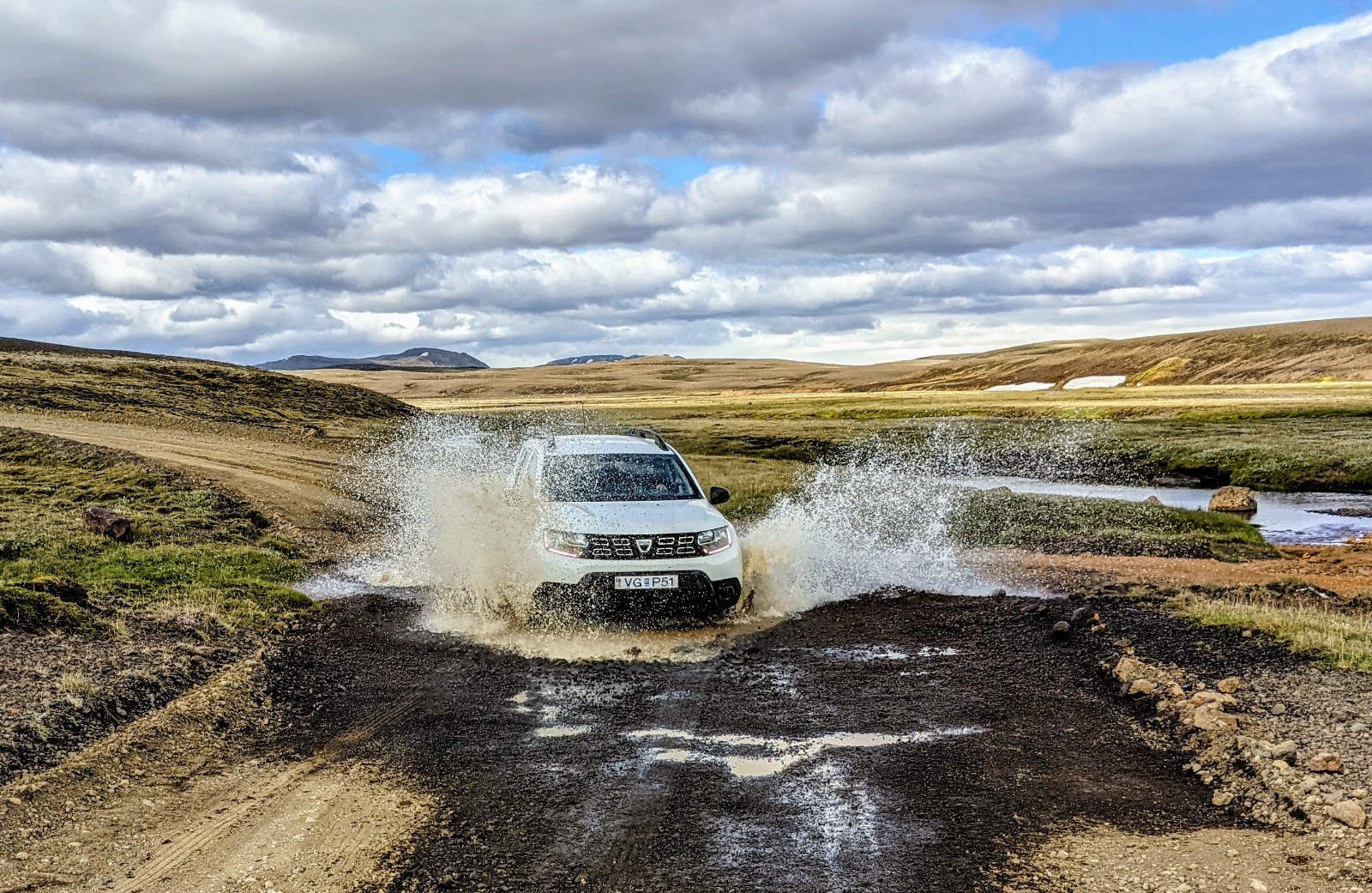
When booking, make sure the vehicle is specifically approved for F-roads and the Highlands. Specialist platforms like Northbound Iceland* have a dedicated Highland-approved category, which makes finding the right car much easier.
Important: F-roads in Iceland are only open from approximately mid-June to late September – sometimes shorter depending on weather. The F35 (Kjölur) is usually among the first to open (around 10 June), while the F26 (Sprengisandur) often doesn’t open until late June. Always check current road conditions at road.is before setting out.
Register your route before every Highland drive at SafeTravel.is – it’s free and could save your life. Mobile signal in the Highlands is often non-existent.


Two Categories of 4×4 Rental Cars for the Highlands
There are roughly two types of Highland-capable rental car in Iceland: proper off-road vehicles and urban SUVs. They differ significantly in off-road capability, comfort and price.
Proper Off-Road Vehicles
These are high-end models like Land Rover and Jeep – built for serious terrain. They typically have low-range gearing, selectable 4WD, high ground clearance and good wading depth. Essential for deep river crossings.
Proper off-road rental cars in Iceland include:
- Land Rover Discovery
- Land Rover Defender
- Toyota Land Cruiser
- Toyota Hilux
- Mitsubishi Pajero
Many of these have a snorkel (a raised air intake at the front) that allows wading through deeper water (50 cm to 1 metre). Even so, some rivers are too deep for any vehicle – always ask local rangers or drivers coming the other way before attempting a crossing.

If even a proper 4×4 can’t get through, you need a Super Jeep – which can’t be hired independently. You’d join an organised tour instead, which takes you to places no normal vehicle can reach (such as Þórsmörk).
Urban SUVs
These look like off-road vehicles but aren’t really – they’re the kind of cars people drive to the supermarket in Germany or the UK. Slightly higher than a normal car, more robust-looking, and with AWD.
They won’t be mistaken for serious off-roaders in Iceland, but they are approved for F-roads and the Highlands.
Typical urban SUVs available as Iceland rental cars:
- Dacia Duster
- Suzuki Jimny
- Suzuki (Grand) Vitara
- KIA Sportage
- Toyota RAV4
Urban SUVs cost a fraction of a proper off-roader – often half the price or less. Most travellers end up choosing between the two most popular budget 4×4 rental cars in Iceland: the Dacia Duster and the Suzuki Jimny.
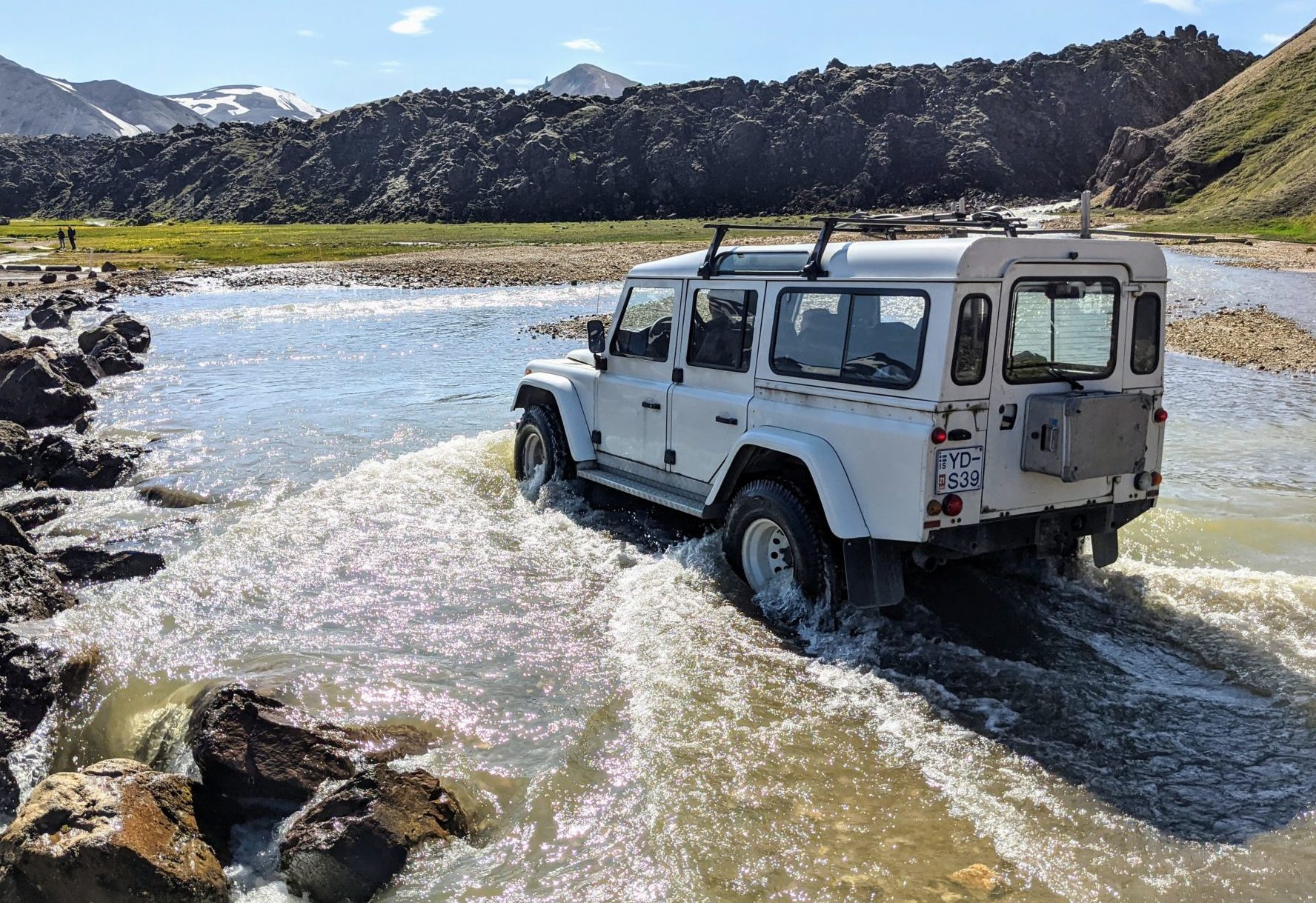
Both are budget options but genuinely capable AWD vehicles. Experienced off-road drivers may scoff, but in our view both cars will get you safely through the Highlands – as long as you’re careful on rough tracks and particularly at river crossings.
River Crossings
If you can’t see the bottom of a ford, wait for another vehicle to cross first so you can judge the depth. Or wade through yourself in shorts – if the water stays below your knees, the car should be fine. Always err on the side of caution and turn back if in doubt.
Important: Off-road driving is strictly illegal in Iceland for all vehicles – even off designated tracks. Iceland’s fragile moss and vegetation recovers extremely slowly from tyre damage. Fines are severe.
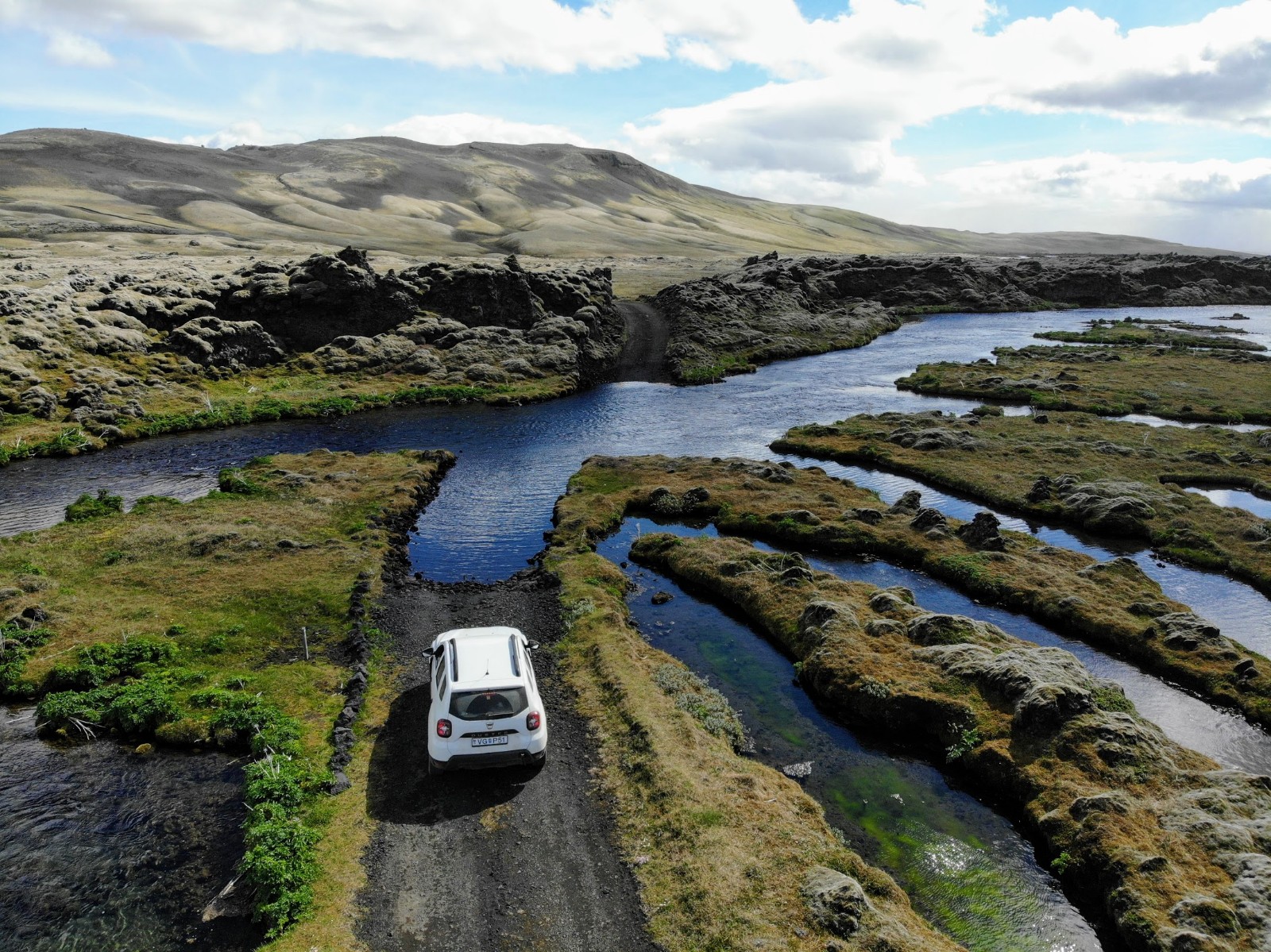
Our Recommendation: Dacia Duster Iceland – Best Budget 4×4
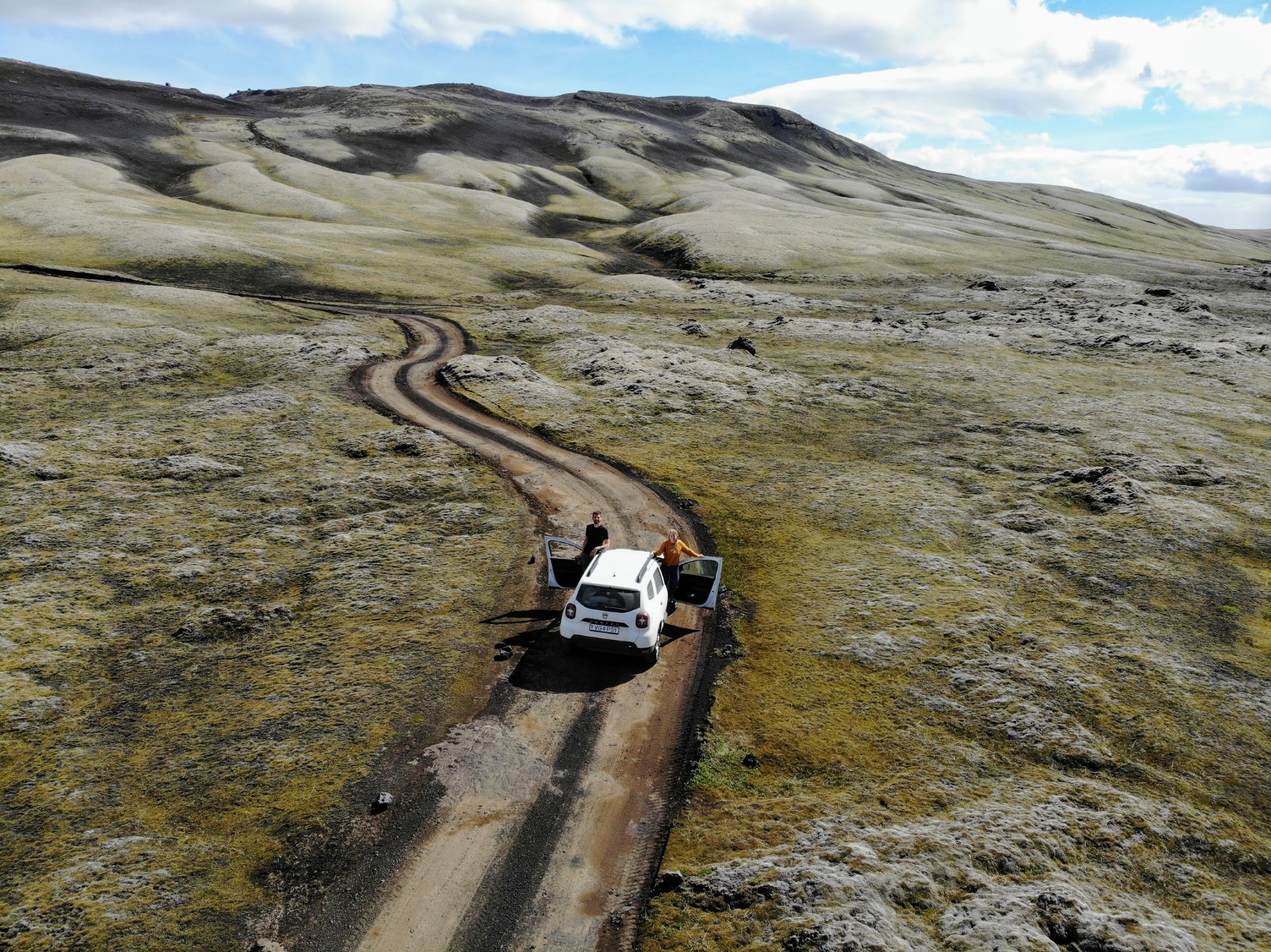
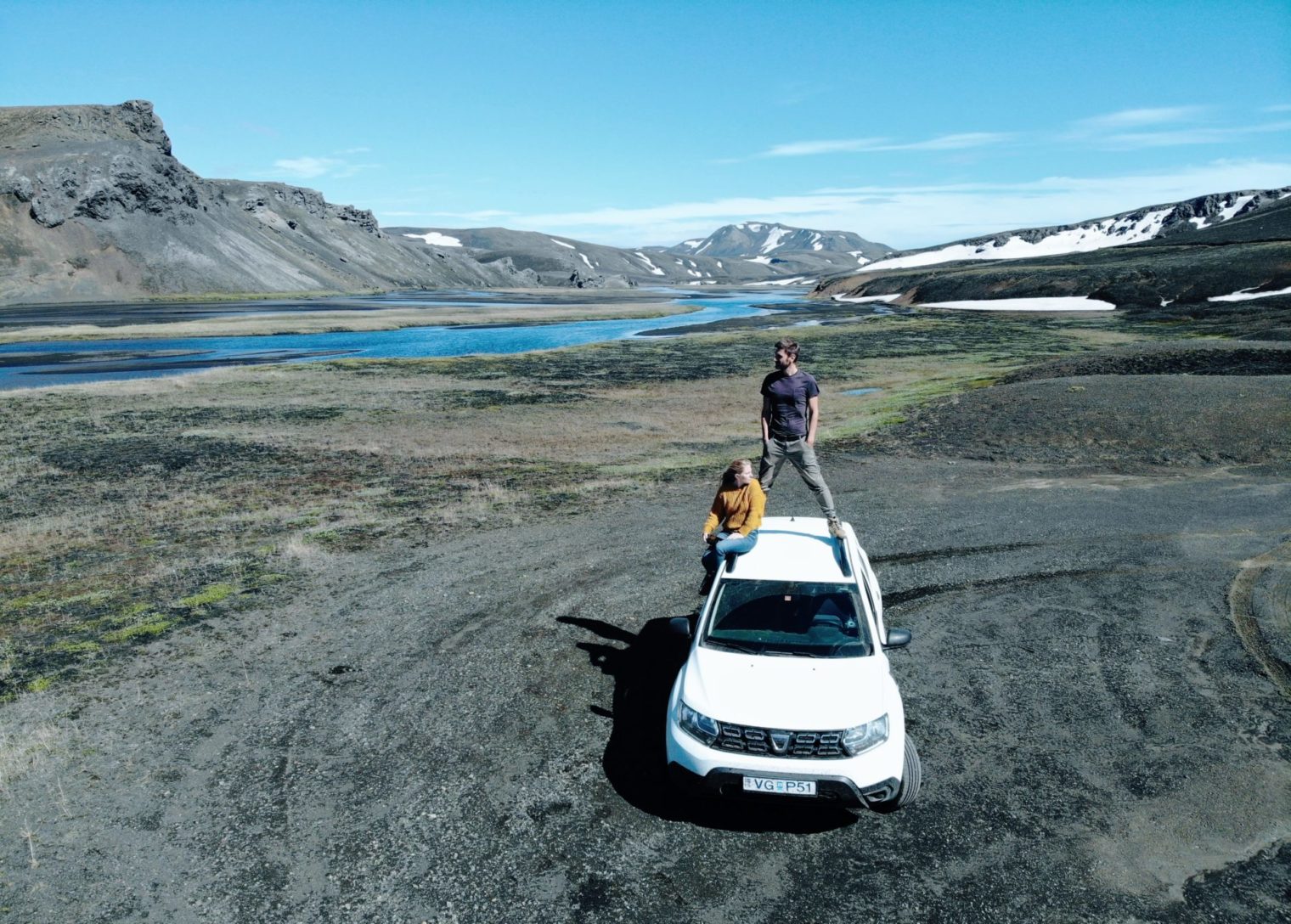
We drove a Dacia Duster Iceland for four weeks – Ring Road, F-roads, Highlands, and several river crossings. When we returned the car, it was filthy inside and out. The rental company employee’s verdict: “It looks like you had a lot of fun.”
The Duster isn’t a perfect off-roader. But it’s affordable, reliable and will take you a very long way in Iceland – including into the Highlands. For the really deep fords you’ll have to turn back, but that’s equally true of cars costing four times as much if you don’t have the experience.
It seats four comfortably and handles the journey very well. Our clear recommendation for a 4×4 Iceland self-drive on a budget.
What to Look for in a 4×4 Iceland Rental Car
Whatever type of 4×4 you rent, two things matter most for Highland driving:
- Ground clearance: The gap between the undercarriage and the road surface. Essential on rocky tracks.
- Wading depth: How deep the car can go in water before damage occurs. The air intake (usually behind the grille) is the critical point, along with electronic components in the lower part of the vehicle. A useful overview of wading depths for common SUV and 4×4 models is available here.
A proper off-roader scores much higher on both counts than an urban SUV, but for straightforward Highland tracks (F-roads) without serious river crossings, a Dacia Duster is fine.
Where to Book Your Iceland Car Rental
We recommend booking through Northbound Iceland – an Iceland-only comparison platform that lists all local rental companies in one place. It’s especially good for finding Highland-approved vehicles, campervans and roof tents.
northbound.is* is a specialist price comparison site for Iceland car rentals only. You’ll find everything from small cars to campervans, roof-tent SUVs and large off-roaders.
All vehicles can be cancelled free of charge up to 48 hours before pick-up – so you can book early without committing.
Northbound.is – Iceland Car Rental Specialist
 Northbound.is
 Northbound.is
- Compares all Icelandic rental companies
- Specialist in Iceland self-drive and Highland vehicles
- Iceland-specific insurance options available
- Free cancellation up to 48h before pick-up
- Small cars, campervans, motorhomes, SUVs (with roof tent) & 4x4s
Iceland Car Rental at northbound.is*
Iceland Car Rental – Practical Tips: Pick-Up & Drop-Off
Where to Pick Up Your Car
The best option is to pick up directly at Keflavík International Airport. You’re mobile immediately – no shuttle or transfer to Reykjavík needed – and most companies offer 24-hour service there. Picking up in Reykjavík makes sense if you’re spending your first night in the city anyway.
Tip: Avoid one-way rentals (different pick-up and drop-off locations) – these often come with a significant extra charge.
Don’t Book at the Airport Counter
Always book your Iceland rental car online in advance – walk-up prices at the airport are significantly higher than pre-booked rates. Book early in peak season (July/August) as availability drops fast.
Document Damage at Pick-Up
Before driving off – photograph the entire car from all angles including the underside and roof. Report any existing scratches, dents or damage to the rental company and get written confirmation. Also photograph the fuel gauge and odometer at pick-up and again at return.
Fuel Policy
Most companies hand over the car with a full tank and expect it back full (full-to-full policy). If you return it less than full, the missing fuel will be charged at a heavily inflated rate. Fill up shortly before returning.
Allow Time for Drop-Off
Plan to return the car at least 2 hours before your flight. At Keflavík Airport there can be queues and you still need to take the shuttle to the terminal.
Iceland Car Rental Insurance – What Do You Actually Need?
Icelandic rental companies offer a range of insurance add-ons – some familiar, some unique to Iceland. Here’s what you need to know.
Our Iceland Car Rental Insurance Recommendations
- ✅ CDW/SCDW (Collision Damage Waiver) – essential, ideally with zero excess
- ✅ Gravel Protection (GP) – essential; stone chips and windscreen damage are the most common claims in Iceland
- ⚠️ Sand & Ash (SAAP) – optional; storms are rare but possible
- ❌ Theft Protection (TP) – can be skipped; theft rates are very low
- 💧 River Crossing Protection – only if you’re planning to ford rivers (only available via Lotus Car Rental on northbound.is)
Collision Damage Waiver (CDW)
The CDW limits your liability if you damage the car. Your excess (the amount you’d pay in a claim) is typically blocked on your credit card as a deposit.
If your CDW is €2,000, that’s the maximum you’d pay for covered damage. Note: river crossings are not covered by standard CDW. If you damage the car in a ford, you’re liable for the full repair or replacement cost.
Gravel Protection (GP)
Protection against stone chip damage to the bodywork and windscreen. Given Iceland’s road conditions, this is a must. Stone chip damage is the most common claim on Iceland rental cars and is not covered by standard CDW.
Theft Protection (TP)
Covers theft of the vehicle. In our view you can skip this one – theft rates for rental cars in Iceland are very low.
Sand & Ash Damage Waiver (SAAP/SADW)
Protection against sand and ash storms. These do occur in Iceland but are rare and usually well-forecast. If a storm is predicted, don’t drive into it. We’d call this optional rather than essential.
River Crossing Protection (Platinum Cover at Lotus Car Rental)
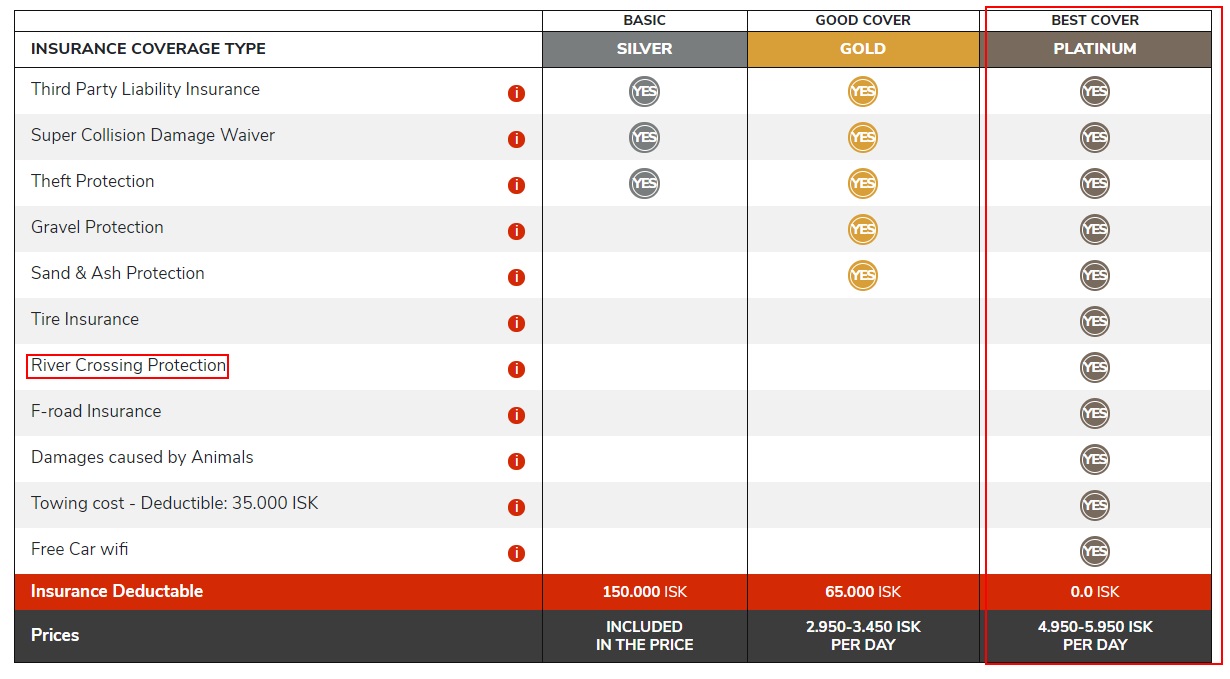 Lotus Car Rental (bookable via northbound.is*) is currently the only company in Iceland offering insurance that covers river crossings. Their Platinum Cover package includes River Crossing Protection alongside all other add-ons.
Important: Your credit card for the rental deposit must be in the main driver’s name – not a travel companion’s. Prepaid or virtual cards are generally not accepted. Check this before booking.
Iceland Car Rental Prices 2026 – What Does It Cost?
Iceland car rental prices are noticeably higher than in mainland Europe – and they’ve risen further since 2021. Here are the approximate 2026 prices:
Small car (e.g. Toyota Aygo, Hyundai i10) per week:
- From approx. €200–280 (shoulder season)
- From approx. €250–350 (peak season July–August)
SUV/4×4 (e.g. Dacia Duster, Toyota RAV4) per week:
- From approx. €300–450 (shoulder season)
- From approx. €400–600 (peak season)
- From approx. €600–900 with roof tent
Large 4×4 (e.g. Land Rover Defender, Toyota Land Cruiser) per week:
- From approx. €680–1,500
Prices include the cheapest insurance option. Full coverage adds roughly 50% to the base price. From 2026, add the new kilometre charge of approx. 1,395 ISK/day (~€9–10).
New from 2026: Iceland introduced a kilometre-based road charge from 1 January 2026, replacing most fuel tax. This costs either a flat daily rate of 1,395 ISK (~€9–10) or is calculated per kilometre driven, and is settled at the rental counter. Factor this into your budget.
Iceland Campervan Rental – Road Trip with a Roof Tent
Campsites are plentiful in Iceland (full map here) and most also offer wooden huts for rent – though these book up quickly. A campervan or roof tent gives you much more flexibility.
Wild camping is no longer permitted in Iceland (unlike in Norway) – you must use official campsites. The good news: Iceland has over 170 campsites, many very affordable. With the Iceland Camping Card (approx. €229 for 28 nights) you can save significantly on longer trips.
There are two types of campervan rental in Iceland: a standard campervan (you sleep inside the vehicle) or a 4×4 with roof tent (you sleep on top of the vehicle).
Campervans in Iceland
 In a standard campervan you sleep inside the vehicle, which typically includes a mattress and sometimes a small kitchen or toilet. Most campervans in Iceland are not available as 4×4 vehicles – which means the Highlands are off limits.
That said, you’re free from hotel bookings and can stop whenever and wherever you find a campsite.
Iceland 4×4 with Roof Tent
A roof tent is a large tent mounted to the roof rack of a 4×4. You climb in via a ladder, have reasonable space and a proper mattress. We’ve done road trips with roof tents in Tanzania and Argentina and think it’s a great system. Set-up takes just a few minutes, the mattress is far more comfortable than sleeping on the ground and the whole thing folds away neatly.
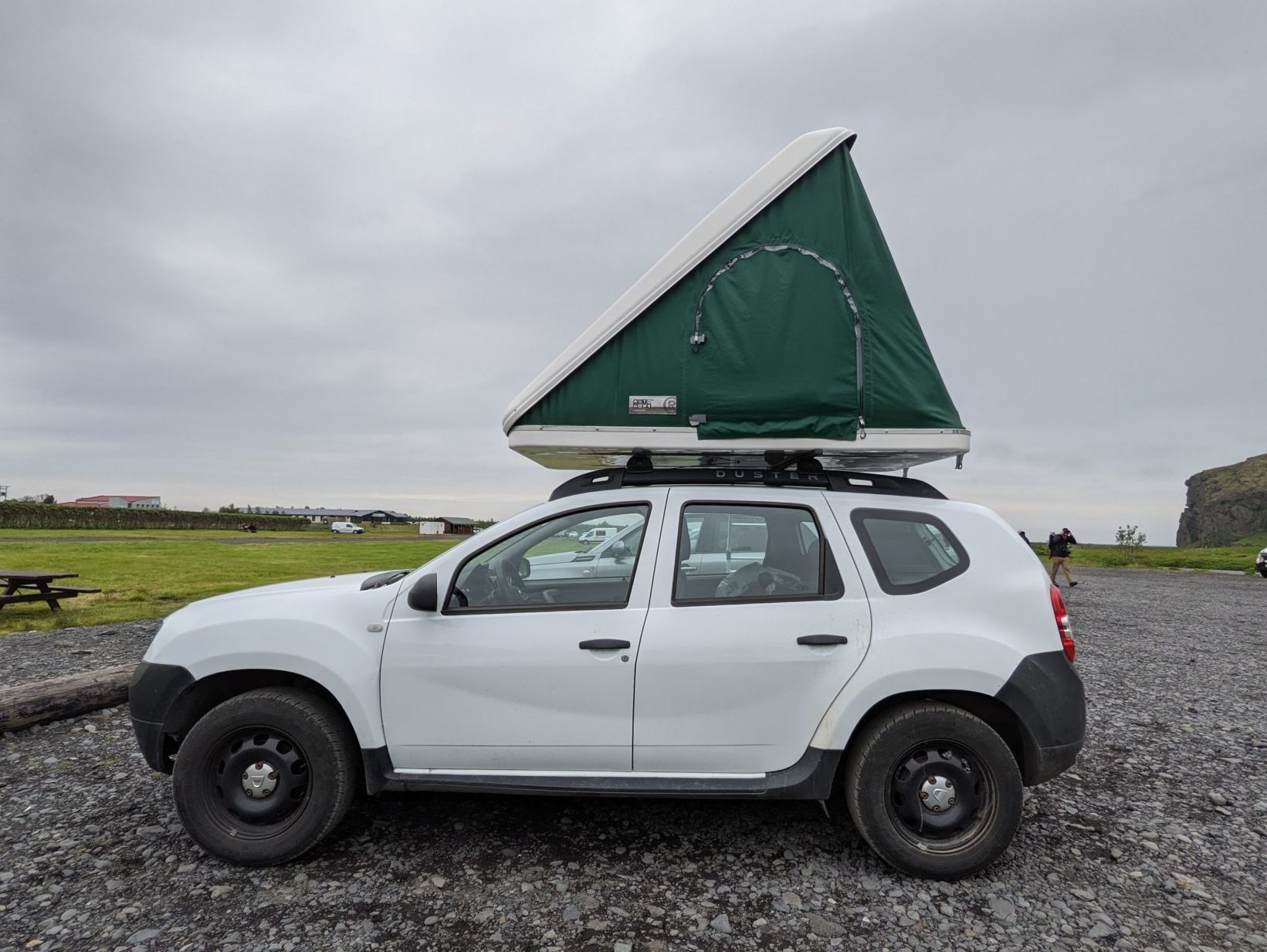 Because the roof tent doesn’t affect the vehicle underneath, you can rent a 4×4 with roof tent and still access the Highlands and park at any campsite.
In heavy rain or strong wind it has its downsides – but you can always retreat into the car or book a hotel.
Our recommendation: A campervan or roof tent makes most sense in Iceland between mid-May and early October. In winter many campsites are closed and temperatures in a campervan can get very uncomfortable.
Need more tips for your Iceland road trip? We have a dedicated guide covering everything you need to know before your first Iceland self-drive:
Iceland Travel Tips | Everything You Should Know Before Your First Road Trip
Frequently Asked Questions: Iceland Car Rental
Do I need a 4×4 in Iceland?
Not necessarily. For a summer trip on the Ring Road, a small car is perfectly fine. You need a 4×4 if you’re heading into the Highlands (F-roads, legally required), travelling in winter or planning to explore secondary roads off the Ring Road. In autumn and spring we’d recommend at least a mid-size car.
How much does a rental car in Iceland cost in 2026?
Small cars from approx. €200–280/week, SUV/4×4 from approx. €300–450/week (shoulder season). From 2026 add the new kilometre charge of approx. 1,395 ISK/day (~€9–10). Full insurance coverage adds roughly 50% to the base price.
Where is the best place to book an Iceland rental car?
We recommend northbound.is* – an Iceland-only comparison platform. You’ll find all categories from small cars to large 4x4s and campervans, with transparent insurance options and free cancellation up to 48 hours before pick-up.
Can you drive off-road in Iceland?
No – off-road driving is strictly illegal for all vehicles in Iceland. Iceland’s fragile vegetation recovers extremely slowly from damage. Fines are severe and can include criminal charges.
Got more questions about renting a car in Iceland or tips to share? Leave a comment below.
Pingback: Best Time to Visit Iceland for Outdoor Adventure - Explorer Chick