


This Croatia itinerary for 10 days takes you down the Adriatic coast: from the Velebit via Zadar, Split and the island of Brač to Dubrovnik, and back north to Plitvice Lakes. We visited Croatia in 2017, 2022 and most recently in 2025, and have driven the route several times, first in a rental car and later in our camper, and have since expanded it with the island of Brač, Primošten and the Velebit.
Below you will find the complete route with map and stage table, the national park entrance fees for 2026, how to get there by plane, the tolls in Croatia and variants for 7 and 14 days.
The stages are short, mostly under two hours of driving. The route runs from north to south, and Plitvice is on the way back, so you never have to drive a stretch twice.
Last updated: November 2026
Getting to Croatia: Fly In and Rent a Car
The easiest way to do this route is to fly into Zadar or Split and pick up a rental car at the airport.
Flying to Croatia
The best airports for this route are Zadar or Split. On our first Croatia road trip we flew to Zadar and picked up our rental car right at the airport. In summer, Dubrovnik also has direct flights. How to drive the route as a loop from one airport is explained below in the section on variants.
One more tip: If a few extra euros do not matter on your vacation, rent a convertible. Driving along the coast with the top down and an open view in all directions is simply fantastic.
You should book the rental car early, because in high season the supply on the coast quickly runs out. Also make sure that driving to Bosnia and Herzegovina is allowed if you plan a detour to Mostar.
Tolls in Croatia
Croatia has no vignette, but distance-based tolls on its motorways. You take a ticket when you enter and pay when you exit, based on the distance driven.
This is changing right now: On March 1, 2027, Croatia switches to an electronic system in which license plates are recorded automatically or an ENC transponder rides along in the car. Cars and motorcycles up to 3.5 t can choose between license plate registration and an ENC device, while the transponder becomes mandatory for vehicles over 3.5 t. Cash payment on the motorway will then be discontinued. In 2026 the transition phase with the familiar toll booths is still running.
Good news for the drive to Dubrovnik: The Pelješac Bridge is toll-free. More on that below on Day 8.
Croatia Itinerary 10 Days – Map and Stages
The route follows the coast from north to south. The first stop is Paklenica National Park in the Velebit, which lies right on the coastal road. After that it goes via Zadar, Primošten and Krka National Park to Trogir and Split, with an island day on Brač. Further south follow Omiš, Makarska with the Skywalk Biokovo and finally Dubrovnik via the Pelješac Bridge.
On the way back north you take in Plitvice Lakes, which lie on the A1 towards Zagreb anyway. That way you never drive a stretch twice.
On our Google Maps map you will find the route with all stages, highlights and accommodations:
The stages at a glance
10 days in total, from north to south and back via Plitvice. You will find variants for 7 and 14 days further down.
Best time to travel in Croatia
The best time for this route is May, June and September. In July and August the coast is very crowded, and the national parks cost the most then: Krka and Plitvice charge €40 admission from June to September, and in April, May and October it is €20 and €23 respectively. If you are flexible, you save around €20 per person and park in May or early October.
A trick for high season: In Krka National Park a reduced price of €30 instead of €40 applies from 3 p.m. The waterfalls are also much emptier in the late afternoon.
What to expect on the route
- Three national parks (Krka, Plitvice, Paklenica) and Biokovo Nature Park
- Two UNESCO old towns: Dubrovnik and Trogir
- Short stages, mostly under two hours of driving
- Pebble beaches, bathing coves and a real sandy beach in Omiš
What to keep in mind
Croatia has used the euro since January 1, 2023, and the kuna no longer exists. Since the same date the country has also been part of the Schengen Area. You can pay by card almost everywhere.
Pack water shoes. Most beaches in Croatia are pebble or rock beaches, and barefoot it quickly becomes uncomfortable.
Croatia Itinerary Day by Day
Day 1: Paklenica, Velebit and the Winnetou Gorge
Paklenica National Park is the first big stop. It lies near Starigrad right on the coastal road, about 45 minutes north of Zadar, which makes it a perfect start: you are out of the car and in the middle of nature.
Paklenica National Park is the southern part of the Velebit, Croatia’s largest mountain range. The park is a paradise for climbers, whom you can see hanging on the steep rock walls all over the park. But hikers are well catered for too. There are numerous hiking trails that lead you through the entire area of the national park.
In Paklenica National Park we visited the Manita Peć cave, which we can definitely recommend.
Admission:
- June to September: adults €10, children €5
- March to May and October: adults €6, children €3
- Winter months: adults €4, children €2
- The Manita Peć cave costs an additional €5 for adults and €2.50 for children and is open from March to October
The Manita Peć cave
You can only visit the cave on a guided tour, and only between 10 a.m. and 1 p.m.! When we arrived at the top, the guide and 4-5 other hikers were already waiting for us, and after a short wait we went into the cave. It was about 50-60°F (10-15°C) inside, which actually sounds cold. With outside temperatures of over 85°F (30°C), however, it is a nice cool-down. That is why we of course had no jackets with us, unlike apparently all the other hikers. The guide kindly offered us fleece jackets, which, to be honest, we would not have needed. Because as I said… we were glad about the cool air and the lack of sun in the cave.


The tour through the Manita Peć cave
The tour in the cave was quite entertaining and we heard many facts about the history of the cave. Unfortunately you were not allowed to take photos with a flash in the cave, which did not exactly help our souvenir photos (That is why there are none from inside the cave here!).
After half an hour the tour was already over and we made our way back. There are of course bigger caves in the world, and the way up was not the easiest. Still, we did not regret it. But if you are not really interested in stalactite caves, you should rather do a classic hike in the park. There are enough routes there.
The Zrmanja Gorge
Take some time on this day for the Winnetou Gorge. We could not care less about the Winnetou movies, but the gorge looked so spectacular in the photo that we simply had to see it. It lies in the hinterland between Paklenica and Zadar and therefore fits well into this stage.
The way there is not quite so easy to find. At a certain point you have to leave the main road (a small sign also points to the viewpoint there) and then drive a few hundred more meters along an unpaved road until you finally reach the gorge. There you have an amazing view.
You can find the exact viewpoint here on Google Maps!

Our hotel near Paklenica National Park

We stayed in a small but very nice accommodation in Rovanjska. Rooms & Appartments Dora* is located in the immediate vicinity of Paklenica National Park and also close to Zadar, so it works for this stage and the next. The rooms are decorated very nicely. The highlights, however, are definitely the tortoises in the courtyard and the excellent breakfast.
The owner Dora bakes super delicious muffins every morning and makes sure you start the day full and happy.
Bed & Breakfast Dora on Booking.com*
Day 2: Zadar
From Paklenica it is only about 45 minutes until you reach Zadar . We had first thought of the city as the usual gateway for the budget airlines and otherwise not worth mentioning. But that is not the case. Zadar has a really beautiful old town, lies right on the sea with a lovely promenade, and you can spend your time there really well.
The old town of Zadar is a real open-air museum with beautiful buildings, historic excavation sites and narrow alleys to stroll through. There are also many restaurants and bars to linger in and plenty of souvenir shops to buy keepsakes.
The Sea Organ
The best-known (and surely also most modern) sight in Zadar is certainly the Sea Organ, which is – oh wonder – right on the sea. It is a stone staircase leading into the sea, with underground pipes built under it that produce organ-like sounds through the movement of the waves. Fascinating and definitely a major tourist attraction.
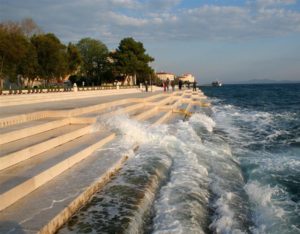
Right next to it on the waterfront promenade is the “Greeting to the Sun”. This is another modern work of art made of many illuminated glass plates that you can even walk over. In the evening hours the “Greeting to the Sun” is heavily visited, as many tourists come here for the sunset and watch the colorful light shows under the glass plates. So plan your evening in Zadar around the sunset.
Blind, deaf and fluffy
On our walk back to the old town to buy a few souvenirs, we suddenly heard a soft squeaking. We followed the sounds and could not believe it at first, because next to a doorway there was a barred enclosure from which about half a dozen baby kittens along with their mother cats squeaked at us. What an incredibly cute spectacle. Some of the little creatures were so young that their eyes had not even opened yet after birth.
Sabrina’s helper instinct was of course awakened immediately and we thought about a way to do something good for these little creatures. We quickly went to the nearest DM (yes, they exist in Croatia too) and bought some cat food and cat milk. We put the treats out for the hungry little fur balls and watched for a while as they dug in.
Where to stay in Zadar


Day 3: Primošten, Skradin and Krka National Park
From Zadar it is about 90 minutes to Primošten, and the stop is worth it. The old town sits on a small peninsula that was originally connected to the mainland by a drawbridge, hence the name. Through a stone gate you enter narrow alleys of stone houses, and at the highest point stands the Church of St. George (Sveti Juraj) from 1485.
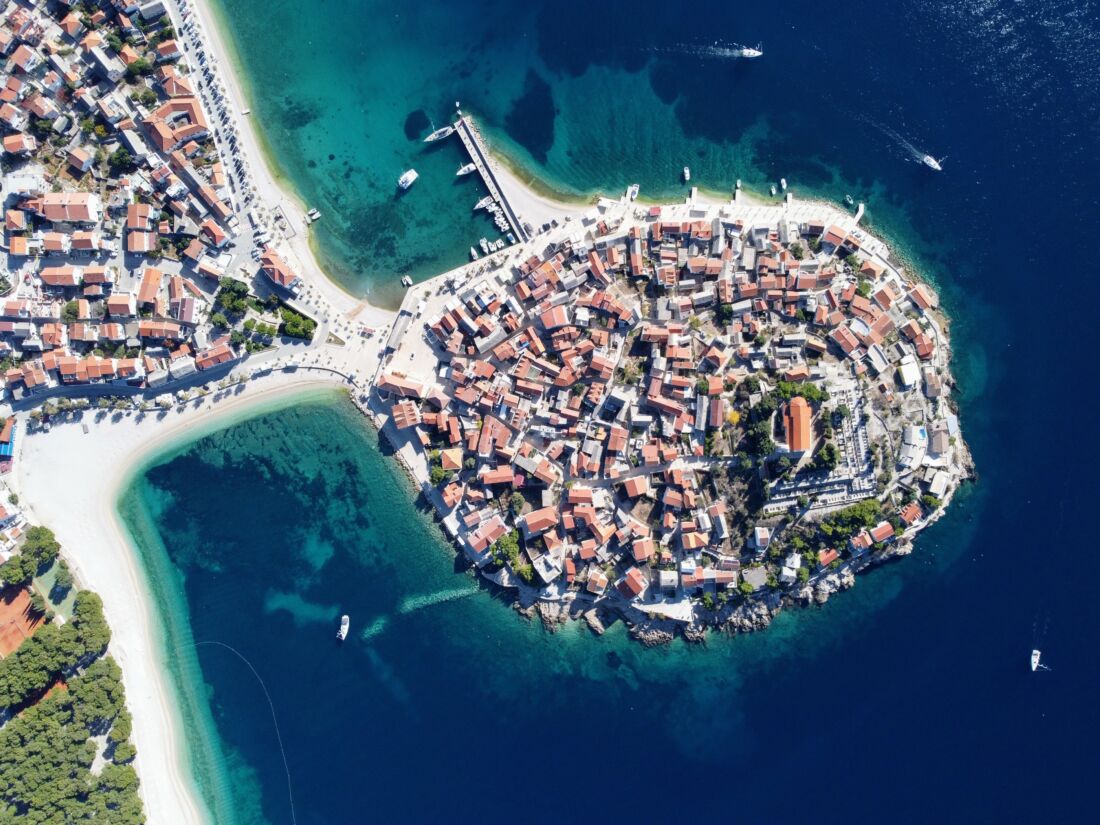
You get the best view from the 17-meter-high statue of Mary above the town, which was completed in 2017. The best way to explore Primošten is simply on foot: walk through the little alleys and along the coast. There are small shops and restaurants, and you can comfortably spend 1-2 hours here.
Another 30 minutes inland to the north lies Skradin. The town itself is really very, very small and serves most people only as a starting point for Krka National Park.
 Still, there is a really great accommodation here where you can relax perfectly before or after your visit to Krka National Park. The Hotel Bonaca* is located at the end of the marina and is a charming little hotel with a great pool. The hotel offers you a super view, and the food in the family-run restaurant is absolutely recommended.
The great Hotel Bonaca on Booking.com*
A boat leaves Skradin every hour to one of the many entrances of the national park. The boat transfer Skradin – Skradinski buk – Skradin is included in the admission from April 1 to October 31, as is the shuttle bus between Lozovac and Skradinski buk. The prices have changed significantly since our visit, and this is the current status:
- June to September: €40 for adults, €15 for children aged 7 to 18
- April, May and October: €20 for adults, €12 for children
- November to March: €7 for adults, €4 for children
- Children under 7: free
Two money-saving tips: From June to September a reduced price of €30 applies from 3 p.m. for adults. And if you only visit the Roški slap section, you pay significantly less there, namely €20 in high season and €12 in the off-season. You can find the currently valid price list at Krka National Park.

Krka National Park
If you want to enjoy Krka National Park without many other tourists, then set off very early. When we were there around 11 a.m., it was already quite crowded. The park is very beautiful, absolutely recommended and one of the highlights of Croatia. A special highlight back then was that you could swim in front of the big waterfall. That is over: swimming has been banned throughout the national park since January 1, 2021. Through the rest of the park you walk over wooden walkways that lead again and again over waterfalls and small pools.

Besides the hikes you can also take different boat tours in Krka National Park. You can head to the island of Visovac by boat, marvel at the Roški slap waterfalls or visit the monastery and the fortress. The boat trips cost extra. The tour from Skradinski buk to the island of Visovac takes about two hours and costs €15 for adults and €10 for children, and it is offered from March to November. You can find all tours at Krka National Park.


After we had seen the first part of Krka National Park, we took the boat back to Skradin and from there drove by car towards Roški slap.
Roški slap
At Roški slap you have the opportunity to go hiking and enjoy a beautiful view of the river. The atmosphere is completely different from the actual Krka National Park (fewer streams and waterfalls), but it is still very much worth seeing. There is a cave here, and you have to earn the sight of it with hundreds of steps.
Unfortunately, the Oziđana cave is not really very long. Although we also spotted a bat there, you do not necessarily have to see this cave. Especially since you have to go all the way back down the mountain to be able to climb the mountain again on the other side (where you have the great view of the river).


This path to the viewpoint over the river, however, is highly recommended. It is rather strenuous, as you walk almost the whole time over the bare, slippery mountain ridge and there are no real paths, but the view from the windy summit is truly fantastic!
Day 4: Trogir and Split
From Skradin it is about 50 minutes to Trogir, and from there another half hour to Split. The two fit well into one day if you start in Trogir and leave Split for the afternoon and evening.
Trogir
It is much quieter and more relaxed in Trogir than in Split. It is worth taking a walk and strolling through the little alleys. Unfortunately it rained a little during our visit. That dampened the mood a bit, but it almost belonged to our Croatia vacation: almost every afternoon there was a short, heavy downpour with occasional thunderstorms. But as quickly as it came, it was usually gone again.
We have the Romans to thank for the special charm and flair of Trogir. They separated the old city center from the mainland with a canal. So today every trip into the old town begins with crossing the old bridge and the arduous search for a parking spot. We parked right outside the old town (namely here) and then walked about 10 minutes. That was no problem and stress-free.


A multitude of old towers, churches, palaces and winding alleys in the medieval old town make the walk a real experience. There is something new to discover at every corner. From afar you can already see the tall tower of the impressive cathedral, which is also the landmark of Trogir.
If you want to visit the cathedral and its tower, a small admission fee is due, as well as for the Kamerlengo Fortress. The fortress, built between the 13th and 15th centuries, once served the Venetian army as a base and is now the second major sight in Trogir.
Hotel recommendation in Trogir
 Stay near the old town in the beautiful Villa Lucia*. The very modern apartments offer everything you need, and the hosts are always on hand with help and advice.
Split
Split is probably on the program of most Croatia trips, and it was crowded accordingly. Split is one of the big tourist hotspots in Croatia, so you hardly have the chance to enjoy the city in peace. That bothered us, even more than in Dubrovnik.
Still, you should see the center, because Split has a special feature that you will not find anywhere else: The old town literally sits inside Diocletian’s Palace. Emperor Diocletian had it built around 300 AD as his retirement residence, and over the centuries the city grew between and into the palace walls. Today you walk through alleys whose walls are Roman masonry. The complex has been on the UNESCO World Heritage list since 1979.
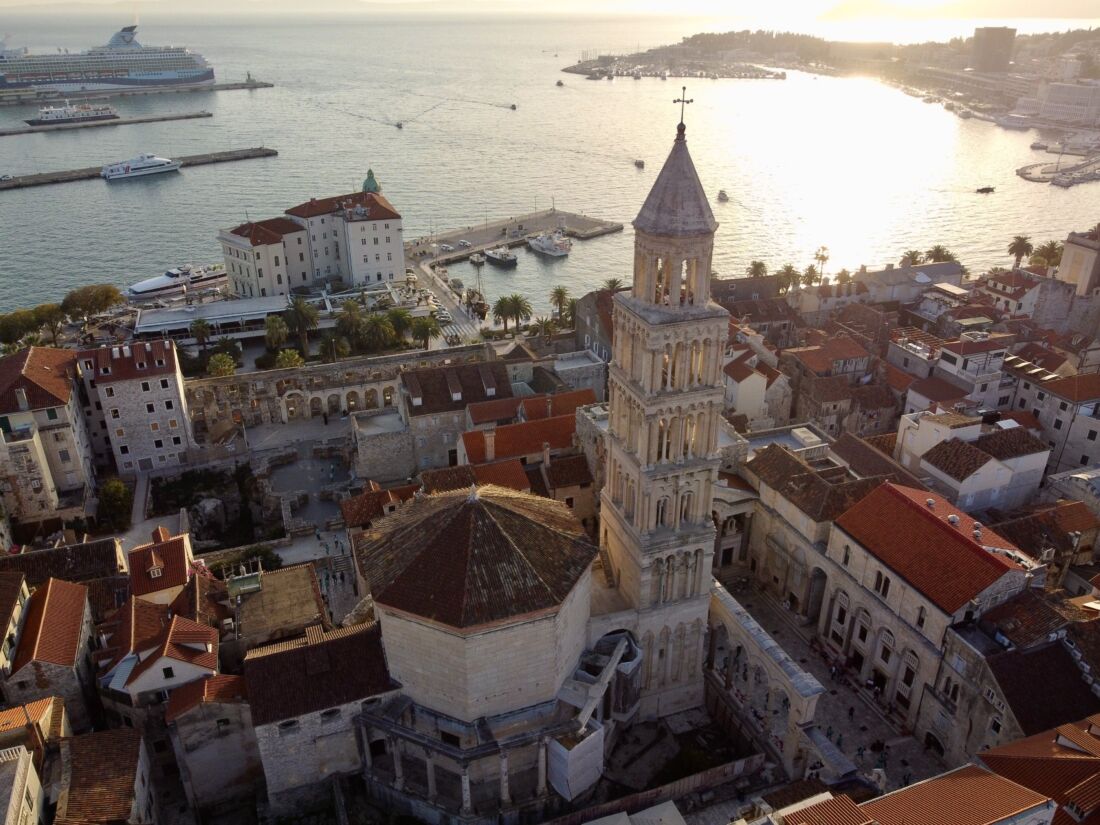
The highlights in the palace are the courtyard Peristyle, the Cathedral of St. Domnius, which stands in the emperor’s former mausoleum, and the cellar vaults under the palace. Afterwards the waterfront promenade Riva is worth a stroll. If the crowds become too much for you, do as we did: Escape to the local mountain Marjan, where it is quiet even in August and you have a view over the city and the islands.


Day 5: The island of Brač
From Split, an island day on Brač, the largest island in Dalmatia, is a good option. The car ferry runs from Split to Supetar and takes between 20 and 50 minutes depending on the ship. Jadrolinija serves the route year-round, and in summer there are up to 18 connections a day. Important: Only the fast catamarans go to Bol, and they do not take cars. So if you want to take your car to the island, you take Supetar or Milna.
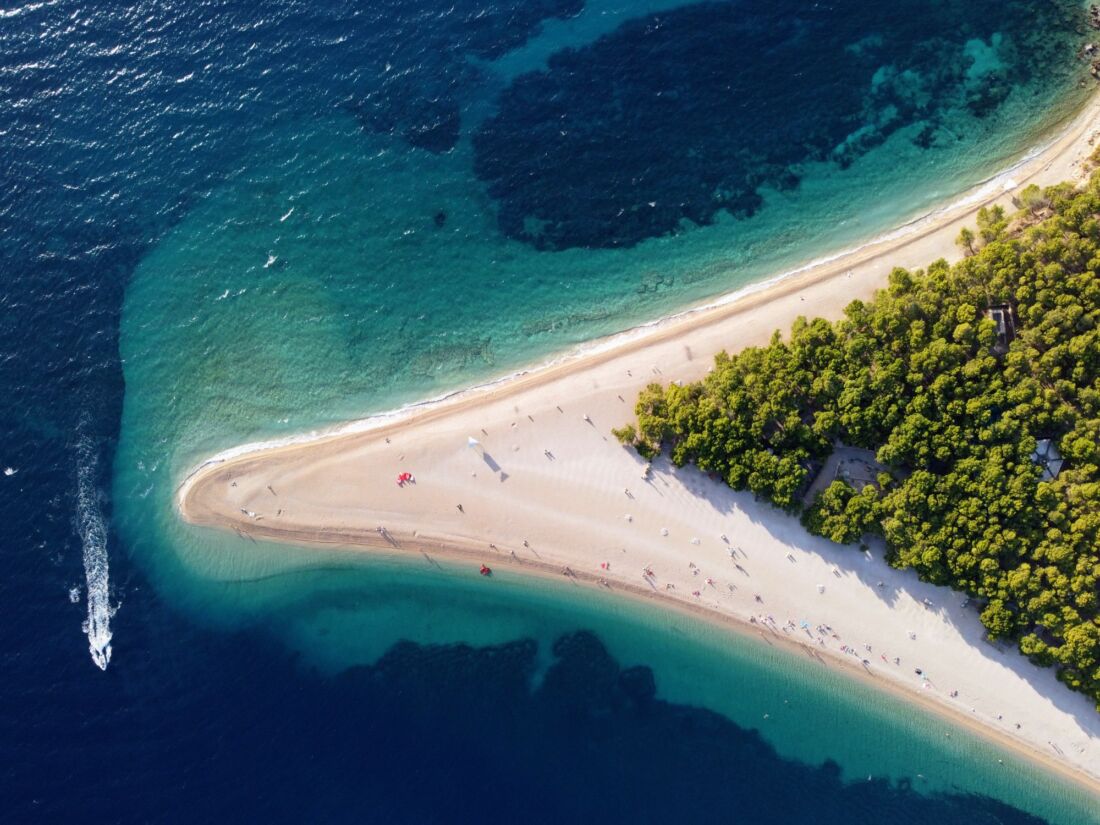
The best-known destination on Brač is Zlatni rat near Bol, the narrow pebble spit that pushes out into the sea and whose shape changes with wind and currents. From Supetar it is about 40 minutes across the island. Above Bol lies the local mountain Vidova Gora, from which you have a view down onto Zlatni rat and, in clear weather, all the way to Hvar. The road up is narrow but paved.
If you would rather sleep on the mainland, the island day also works as a day trip from Split. Then you should keep an eye on the ferry for the return trip, because nothing runs at night.
Day 6: Omiš and ziplining
Back on the mainland it is about 45 minutes from Split to Omiš, one of the shortest stages of the whole route. In Omiš you can do various things, and there is a real sandy beach right in front of the town. That is a real rarity in Croatia.


Our highlight in this town, however, was the ziplining. You slide along a cable, sometimes several hundred meters long, that is strung between two gorges. You glide down this cable at breakneck speed, with nothing but an abyss beneath you, and your heart sinks into your boots during the ride. But it is totally worth it!
You can find a detailed report on this here: Travel report: Insider tip Omiš in Dalmatia | Ziplining and sandy beach
Hotel recommendation in Omiš
 At the Hotel Saint Hildegard* you can treat yourself to a bit of luxury. The hotel is right on the beautiful beach in Omiš and has a dreamy infinity pool with a view of the sea. The rooms are also really stylish and modern. You simply feel right at home here.
The perfect view of the sea on Booking*
Day 7: Makarska and the Skywalk Biokovo
From Omiš it is just under an hour down the coast to Makarska. We only discovered the town by chance, because it is not one of the usual stops on a Croatia road trip. We cannot understand why, because Makarska is beautiful and lies right at a breathtaking nature park.


The scenery that awaits you there, as well as the nearby Biokovo Nature Park, are definitely worth a stay. Makarska is a beautiful little town with a cute harbor and an impressive mountain backdrop behind it.
Hotel recommendation in Makarska
 In Makarska we spontaneously booked a room at Villa Ruza* and can definitely recommend it. The rooms are very nice and have a fantastic view of Makarska and the harbor.
There is a shared kitchen on each floor, so you can prepare something to eat there and enjoy it with the great view.
Biokovo Nature Park and the Skywalk
From the center of Makarska you are at the main entrance of Biokovo Nature Park in about 10 minutes, which is located roughly 6 km east of the town. The area is well suited for hikers and offers a great view of Makarska and the sea in many places. With a bit of luck you may also meet wild horses here.
Since our first visit the big highlight has been added: the Skywalk Biokovo, the first skywalk in Croatia. It sits at an altitude of 1,228 meters at kilometer 13 of the Biokovo road, right next to the info center. The semicircular walkway projects about 11 meters beyond the edge of the cliff and has a floor made entirely of glass. The regular park admission includes the skywalk.
Clear rules apply on the walkway: a prescribed walking direction, a maximum stay of 10 minutes and no more than 30 people at the same time. When it is busy, that means waiting.

If you do not want to hike, you drive up by car. The Biokovo road is 23 km long, single-lane, and leads from the main entrance at 365 meters up to the summit of Sveti Jure at 1,762 meters, the highest paved road in Croatia. It is 13 km to the skywalk, about 30 minutes of driving. The drive over the narrow serpentines is a real adventure, and you should allow an hour per direction. You also have to expect oncoming buses. There are passing places only about every 300 meters. If you like driving on challenging roads, you are exactly right here, everyone else is better off taking a guided tour.


Plan the drive up early. Access through the main entrance is limited to 25 vehicles per hour, and in high season the wait can be correspondingly long. In summer the last entry is at 3 p.m. The park is open from mid-May to the end of September from 6 a.m. to 8 p.m., and in April to mid-May and from October to the end of November from 8 a.m. to 4 p.m. From the end of November to early April, the park and the skywalk are closed.
Day 8: Over the Pelješac Bridge to Dubrovnik
From Makarska to Dubrovnik it is about two and a half hours, and something fundamental has changed on this stage. You used to have to drive a short stretch through Bosnia and Herzegovina, because the coastal strip near Neum belongs to Bosnia. Since mid-2022 there has been the Pelješac Bridge, which at 2,404 meters long spans the sea inlet between Komarna and the Pelješac peninsula and runs entirely on Croatian territory. The border crossings near Neum are thus no longer necessary, and the bridge is toll-free.
Good hotels in Dubrovnik
We have picked out two highly recommended accommodations in Dubrovnik for you:

-
- is located 2 km outside the hustle and bustle and has its own parking spaces. You can relax from the stress at the beach 200 m away and get to the old town easily by bus
- great apartments with a terrace and a small garden
Pure relaxation at the Apartments Timy on Booking*

-
- Here you are in the middle of the old town and can reach all the sights on foot. Parking is a bit difficult here, though.
- Terrace with a great view of Dubrovnik
- the super nice hostess also sells homemade jam, liqueurs etc.
Accommodation at Ante's in the old town on Booking*
Parking in Dubrovnik
Do not drive your car directly into the city. The parking spots at the old town are really extremely expensive. Park outside and take the bus, which is surprisingly easy and saves a lot of money.
We did not have much time on the evening of our arrival and, despite the high price, parked in the biggest parking garage directly above the old town (link to Google Maps). From there it is only a 5-minute walk to the old town. The parking fees there, however, depend on the season and are among the highest in Croatia.
Day 9: Dubrovnik and the city walls
The city walls
On our second day in Dubrovnik we took the bus into the city in the morning to get tickets for the city walls right away. The city walls are the top attraction of Dubrovnik and one of the best-preserved fortification systems in all of Europe. The wall, built in the 8th century, is 1,940 meters long and has 5 fortresses and a total of 16 towers.
There are three entrances to the wall in total:
- In the east of the city right next to St. Luke’s Church
- one next to the Church of the Holy Savior, directly an entrance gate to the old town (that is where we went in)
- and another next to the Maritime Museum and Fort St. John (Ivan)
As you walk around the wall, you pass various fortresses that you can even visit from the inside. The walk along the city walls is wonderful and gives a completely different impression of Dubrovnik.
A lot has changed with the prices, though: Admission now costs €40 for adults and €15 for children, and Lovrijenac Fortress is included in the ticket. And important for planning: From 2026 a reservation is mandatory. When booking you choose a day and a time, and you book through the official Dubrovnik heritage website. Alternatively, you can book the city walls tickets* online in advance. In the main season the city walls are open from 8:00 a.m. to 6:30 p.m., and for shorter hours in the off-season. So simply walking up and getting a ticket at the counter, as we did back then, no longer works.
The wall encloses the city center in an irregular polygon with passages that are sometimes wider and sometimes narrower. On one side you can enjoy the view into the city inside, and on the other the sea and the surrounding hills.


The Stradun and the old town
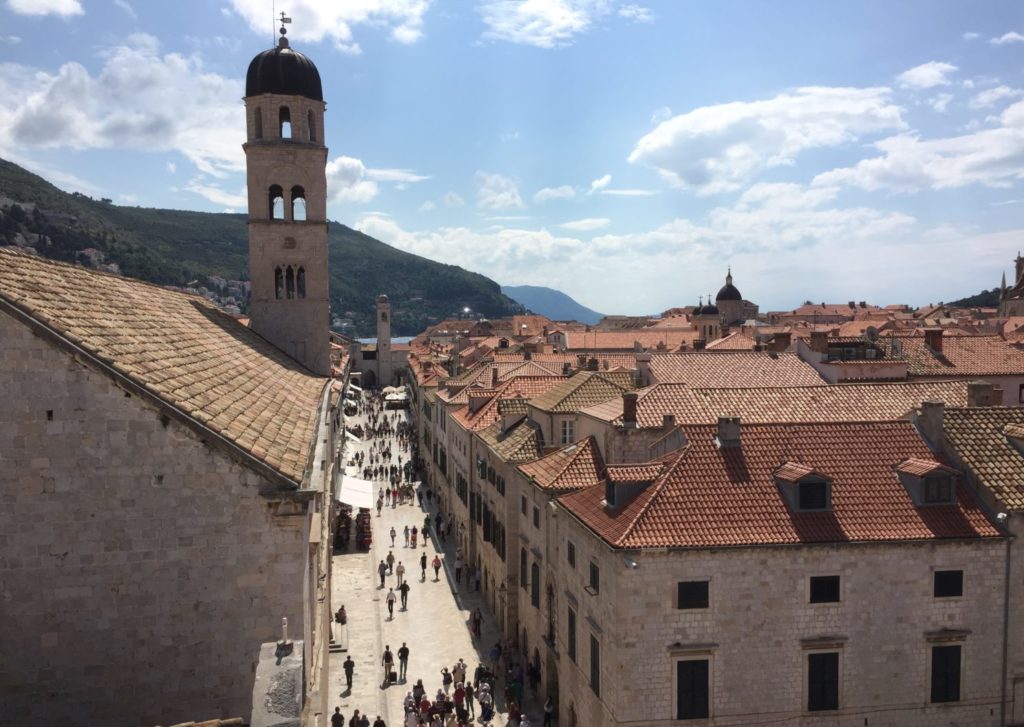
When you leave the wall, you inevitably end up directly in the old town. This UNESCO World Heritage Site combines monuments, baroque buildings and the city wall mentioned above into a very special experience. In the heart of Dubrovnik’s old town is the large pedestrian zone and popular shopping street Stradun (Croatian for “big street”), also called Placa.
Here shops line up next to cafés and baroque buildings next to restaurants. Some of the city’s sights are located on the Stradun. At the end of this street, for example, stands the well-known Orlando’s Column.
The Stradun was built as early as the 11th century. In an earthquake in 1667 it was largely destroyed, but then completely rebuilt. That is why the buildings along the street all look the same.


The cable car
If you still have time and energy afterwards, you can take the cable car up the local mountain Srđ and have another view of Dubrovnik from above. We did not make this trip back then. The cable car is unfortunately not cheap either: The round trip costs €30 for adults, a one-way trip €17. Children between 4 and 12 years pay €8 for the return trip, and up to 4 years it is free.
The operating hours change strongly with the season: From June to August the cable car runs from 9 a.m. to midnight, in April until 9 p.m., and in November only until 5 p.m. From January to March and in December it is closed. The last descent leaves 30 minutes before closing, and operation is interrupted in strong wind. All current times are available at Dubrovnik Cable Car.
We really found the old town of Dubrovnik itself wonderful, and it should be part of every Croatia itinerary. Of course you meet far more tourists here than in most places in Croatia, and when a cruise ship arrives on top of that, then good luck. But that should not keep you from discovering the southernmost tip of Croatia. If you stay away from the big squares, you will hardly meet another tourist and see the real, not quite so polished Dubrovnik.
Day 10: Plitvice Lakes on the way back
From Dubrovnik you head back north, and the last stop is Plitvice Lakes National Park. From the coast near Zadar it is about two hours inland, and from Plitvice the motorway leads straight on towards Zagreb.
The national park is the largest in Croatia by area and also a UNESCO World Natural Heritage Site. Here too the rule applies again: Start your hike through the park as early as possible. If you stay overnight nearby the evening before, you will be at the entrance at opening time and have the wooden walkways almost to yourselves for the first hour.
You can simply drive to the national park by car and park on site in one of the paid parking lots. Here too the prices have risen significantly. A day ticket for adults costs €40 from June to September, €23 in April, May and October and €10 in winter. You can find all information on the website of Plitvice Lakes National Park.

The national park has several hiking routes of different lengths. We chose Route C, which takes about 4-6 hours and consists of a hike and a boat ride. Route C passes the biggest and most impressive waterfalls (“Veliki slap”, “Veliki” and “Mali prštavac”) as well as countless smaller waterfalls. Although we were there early in the morning, it was so crowded in places that you moved across the wooden walkways with a large crowd.
At times whole school classes passed us. Still, this national park is an absolute must on your Croatia itinerary. How the wooden walkways were built directly through and over the water there is truly incredible. It gives you the feeling of really being in the middle of untouched nature, and not just walking through a well-developed national park.

Where to stay near Plitvice Lakes
 A great place to stay is the Plitvice Ethno House*. The hotel is a small oasis near Plitvice Lakes and lies at the edge of a small forest, where there are also great hiking options. Besides modern rooms, a beautiful pool in the green and a sauna await you. Perfect for relaxing after a long day of hiking.
The Plitvice Ethno House on Booking.com*
Shorten or Extend Your Croatia Itinerary
The 10 days are our compromise between coast and national parks. With more or less time the route can be adapted well.
Croatia itinerary for 7 days
With one week we cut Dubrovnik. That sounds harsh, but from Makarska it is two and a half hours each way, and with the trip there and back plus a day in the city, three of seven days are gone. The compact variant instead ends at Makarska and looks like this:
- Day 1: Paklenica National Park and the Zrmanja Gorge
- Day 2: Zadar with old town and Sea Organ
- Day 3: Primošten and Krka National Park
- Day 4: Trogir and Split
- Day 5: Island of Brač
- Day 6: Omiš and Makarska with the Skywalk Biokovo
- Day 7: Plitvice Lakes on the way back
If you still want to see Dubrovnik, it is better to fly there directly and do a southern route of its own.
Croatia itinerary for 14 days
With two weeks it gets relaxed, and you can add the north. This is what we would add:
- Istria: Two days in Rovinj with the old town, Euphemia Church and the forest park Zlatni rt
- Island of Krk: One day on the largest island in Croatia, reachable without a ferry via the bridge. Baška for the beach, Vrbnik for the wine
- Northern Velebit: One to two days for a section of the Premužić Trail from Zavižan
- More island time: Instead of a day trip, two nights on Brač, or on from Split to Hvar
- Šibenik and the Kornati: One day for the old town and a boat tour into Kornati National Park
Croatia itinerary as a loop from the airport
You do not need your own car to get there. On our first Croatia trip we flew to Zadar, took a rental car there and drove the route to Dubrovnik and back as a loop. That works just as well from Split if you want to put the focus further south.
The order of the stages stays the same, only the start and end shift: From Zadar you do Paklenica and the Velebit as a day trip to the north and add Plitvice Lakes at the end before you drive back to the airport. From Split you start with Trogir, drive south first as far as Dubrovnik and take in Zadar, Paklenica and Plitvice on the way back. You should return the rental car at the same airport, as one-way rentals within Croatia are usually much more expensive.
Costs and Practical Tips for Croatia
Admission prices of the national parks
Admission fees are the item that surprises most. In almost all Croatian protected areas the high-season rates apply from June 1:
- Krka National Park: €40 from June to September, €20 in April, May and October, €7 from November to March. From 3 p.m. in high season €30. Children aged 7 to 18 pay €15, €12 and €4 respectively
- Plitvice Lakes: €40 from June to September, €23 in April, May and October, €10 in winter
- Paklenica: €10 from June to September, €6 from March to May and in October, €4 in winter. The Manita Peć cave costs €5 extra
- Dubrovnik city walls: €40 for adults, €15 for children, Lovrijenac Fortress included. Reservation mandatory from 2026
- Dubrovnik cable car: €30 round trip, €17 one way
For two people, Krka, Plitvice and the Dubrovnik city walls alone add up to around €240 in high season. If you travel in May or October, you pay around €166 for the same.
Ferries to the islands
Car ferries run frequently in Dalmatia, but only during the day. To Brač, Jadrolinija takes you from Split to Supetar in 20 to 50 minutes, up to 18 times a day in summer. The fast catamarans to Bol, Milna and Sutivan do not take cars. There are no night ferries, so do not plan the return trip too tightly.
Driving in Croatia
The coastal road is scenic but slow and busy in summer. For longer stages take the A1 motorway inland, for short sections the coast. In the old towns of Dubrovnik, Split and Trogir you do not even need to look for a parking spot, park outside and take the bus or walk the last few minutes.
Packing list for Croatia
- Water shoes, because most beaches are pebble or rock
- Sturdy shoes for Paklenica, Biokovo and the wooden walkways in Krka and Plitvice
- Sun protection and a hat, there is no shade on Biokovo
- Credit card, you hardly need cash
- A thin jacket for the Manita Peć cave, it is 50 to 60°F (10 to 15°C) inside
Our best tips to finish
- If you can afford it financially, book a convertible. The open view of nature you get from it is definitely worth it.
- Since the opening of the Pelješac Bridge in July 2022, the drive to Dubrovnik no longer leads through Bosnia and Herzegovina. If you still want to make a detour, drive via Neum or straight on to Mostar. Then check beforehand whether the rental car contract allows trips to Bosnia and Herzegovina.
- Try to be in the national parks as early as possible, then it is not so crowded yet and you have nature largely to yourselves
FAQ – Croatia Itinerary 10 Days
How long does a Croatia road trip take?
For the coast from Zadar to Dubrovnik plus the national parks Krka and Plitvice you should plan 10 days. A week works too, then we leave out Dubrovnik, because the drive from Makarska alone takes two and a half hours each way. With 14 days, Istria or a second island is added.
Which route fits 10 days in Croatia?
Coming from the north, first Paklenica and the Velebit, then Zadar, Primošten and Krka National Park, Trogir and Split, the island of Brač, Omiš and Makarska with the Skywalk Biokovo. Then over the Pelješac Bridge to Dubrovnik with two days in the city and, on the way back north, Plitvice Lakes. All stages with their days are in the table above.
Do you need a vignette in Croatia?
No. Croatia has no vignette, but distance-based tolls: You take a ticket when you enter and pay when you exit, based on the distance driven. On March 1, 2027, Croatia switches to an electronic system with license plate recognition and ENC transponder, and cash payment on the motorway will then be discontinued.
How much does a Croatia road trip cost?
Admission fees are the biggest surprising item. For two people, Krka, Plitvice and the Dubrovnik city walls add up to around €240 in high season, and only about €166 in May or October. The trip stays affordable with apartments instead of hotels and self-catering.
When is the best time to travel to Croatia?
May, June and September. In July and August the coast is very crowded, and from June 1 the national parks charge double admission. In May and October you pay €20 instead of €40 at Krka and have the wooden walkways much emptier.
Do you have to drive through Bosnia to get to Dubrovnik?
No, not since July 26, 2022. The Pelješac Bridge is 2,404 meters long, runs entirely on Croatian territory and bypasses the border crossings near Neum. It is also toll-free. For motorhomes and trailers the connection became complete with the bypass near Ston in April 2023.
How much is admission to Plitvice Lakes?
A day ticket for adults costs €40 from June to September, €23 in April, May and October and €10 in winter. The parking fee comes on top. The panoramic train and electric boat in the park are included in the admission.
Which island is worth visiting on a Croatia itinerary?
For a single island day from Split, Brač is the best choice, because the car ferry to Supetar takes only 20 to 50 minutes and runs up to 18 times a day in summer. Highlights are the beach Zlatni rat near Bol and the view from the local mountain Vidova Gora.
Did you like our Croatia itinerary for 10 days? Or do you have questions and your own tips about the route? Then feel free to leave us a comment below this article. Thank you!