


Monteverde, Costa Rica, is one of the most famous cloud forests in Central America and home to the colorful quetzal. In this guide you’ll find everything you need for your visit: a comparison of the Monteverde Cloud Forest Reserve and the Santa Elena reserve, current entrance fees, weather and the best time to visit, how to get there, activities and a hotel recommendation. After gray, rainy days in Tamarindo, our Costa Rica road trip took us on to Monteverde, into the cloud forest in the northwest of the country. We expected the cloud forest to be a whole different experience from the rainforests we had visited so far in Costa Rica. I didn’t think we’d get to see the famous, colorful quetzal – whether we did, you’ll find out further down. The drive from Tamarindo was about 160 km (100 miles) on roads of varying quality, up into the mountains.
Last updated: November 2026.
Monteverde Costa Rica: Arriving in the Cloud Forest
Monteverde sits at almost 1,500 meters (4,900 ft), and your rental car has to climb every one of those meters. At what felt like walking speed, our little Suzuki SUV wound its way up the switchbacks. Unfortunately, there wasn’t much of a view along the way. As the name cloud forest suggests, what awaited us was exactly that… tons of fog.
We could only see a few meters through the impenetrable, gray soup. Even though this was typical weather for the area, I wondered how we’d ever spot any animals in the forest in this weather. But since we weren’t planning to go to the park until the next day, it wasn’t a problem yet.

Besides the fog, the climate was also completely different from the Pacific coast we’d just come from. When we arrived in Monteverde in our shorts and T-shirts, we were actually cold. A pretty unusual feeling on this trip. For the first time in weeks, we also had real blankets in our hotel room (Montefresco Hotel Boutique – we can highly recommend the large room with a terrace). We spent the afternoon relaxing on our terrace with a view over the rooftops of the small town and planned our activity for the next day.
Our Hotel in Monteverde: Montefresco Boutique
For a small extra charge, we were able to move into the penthouse room, which was really big, had its own bathroom and even its own huge terrace with a great view. We felt right at home there. There was always a delicious breakfast in the morning, and in the evening we could cook our own dinner in the large shared kitchen.
Monteverde Cloud Forest Reserve or Santa Elena – Which Cloud Forest Park Is Better?
Even if, like us, you’re skipping the many pricey ziplining tours that Monteverde is famous for, you still have to choose between the two parks, La Reserva Bosque Nuboso Santa Elena and the Monteverde Cloud Forest Biological Reserve.
Everyone always talks about Monteverde. Usually, that means the whole region around the cloud forests. There are two private nature reserves in the same mountain region that you can visit. The forest itself is therefore similar in both reserves. Still, there are a few subtle differences, which we’ll run through briefly.
Monteverde Cloud Forest Reserve (info as of 2026):
- Approx. 8 km (5 miles) of hiking, split across 3 trails
- One hanging bridge (included in the entrance fee)
- Very touristy
- Bus from Banco Nacional for $2, 4x daily
- Open 7:30 am-4 pm
- Entrance fee: approx. $29 per person
Santa Elena Cloud Forest Reserve (info as of 2026):
- 12 km (7.5 miles) of hiking trails
- One lookout tower
- Hardly any tourists
- Bus from Banco Nacional for $2, 4x daily
- Open 7 am-3 pm
- Entrance fee: approx. $21 per person
Tip: Prices for foreign visitors are much higher than for Costa Ricans and change from time to time – it’s best to double-check on site or on the official website of the Monteverde reserve or the official website of the Santa Elena reserve. Book tickets in advance: For the Monteverde reserve, it’s best to book your ticket online ahead of time. When booking, you choose one of the three trails and a fixed time slot for your visit.
The three trails in the Monteverde reserve: The entrance fee of approx. $29 per person covers all three trails.
- Essence Trail – approx. 1 hour, 1.4 km (0.9 miles), easy. A short intro featuring a giant, centuries-old ficus tree and the Cuecha Cascade waterfall, ideal if you’re short on time.
- Heart of the Forest Trail – approx. 1.5 hours, 2.8 km (1.7 miles), easy to moderate. Features a hanging bridge, wild avocado trees (food for quetzals), a hundred-year-old mountain mahogany and a strangler fig.
- Continental Divide Trail – approx. 2.5 hours, 4.1 km (2.5 miles), moderate. Starts on part of the Heart of the Forest Trail, including the hanging bridge, then continues to the elfin forest and the Continental Divide and La Ventana lookouts with views toward the Pacific and the Caribbean.


At first, I was a bit skeptical about whether the cloud forest really was that different from the parks we’d seen so far. But it truly is different. The trees and plants are all covered in a thick layer of moss and ferns. Everything is even greener and the forest seems even denser. On top of that, the mist keeps drifting through the treetops and gives the whole place a magical atmosphere. I felt like I had wandered into an enchanted fairy-tale forest as we strolled along the trails.
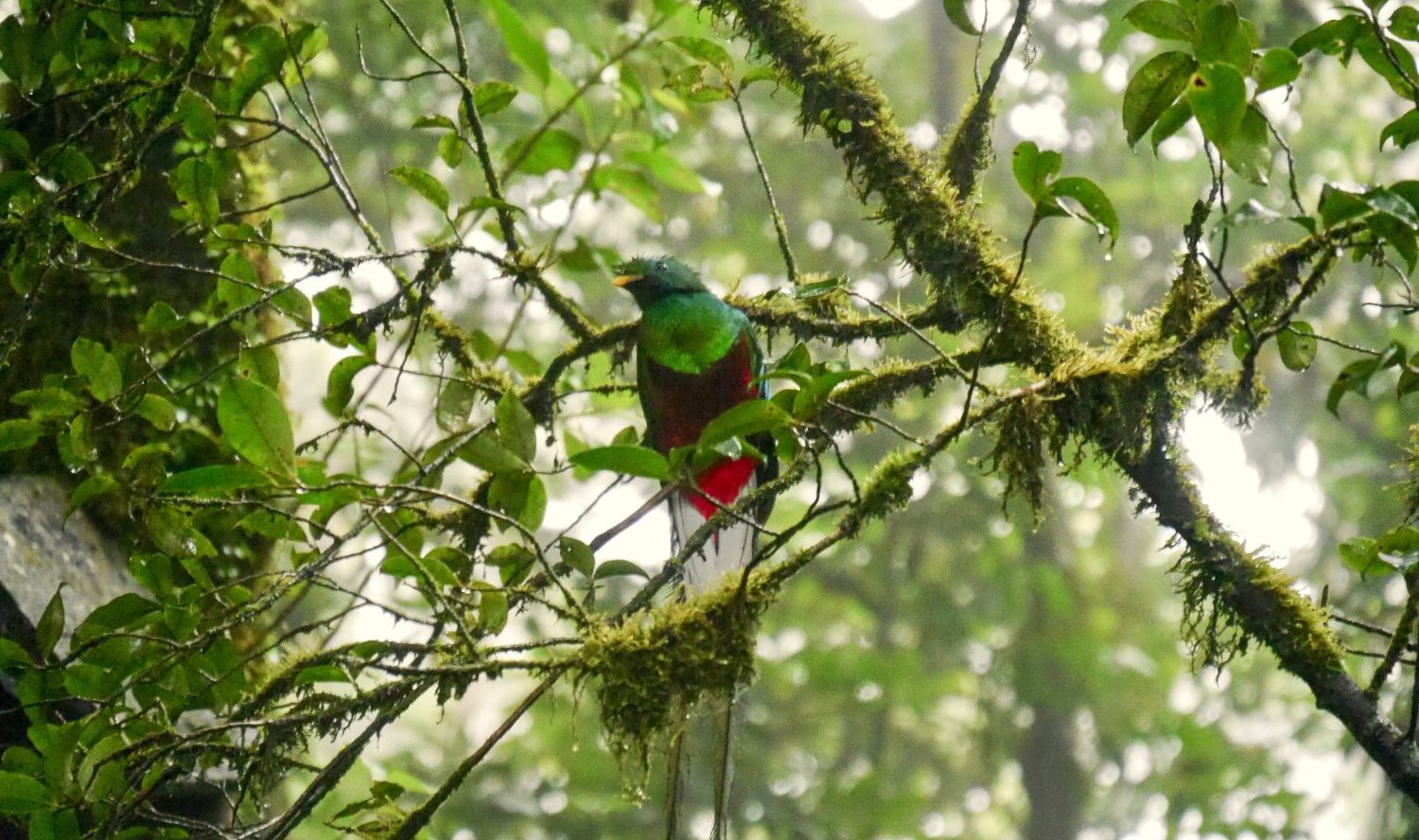
We hardly met any other people on the trails. And the one time we did, they were staring spellbound at a tree. And there he was… with his shimmering green feathers, red chest and long white tail feathers. The quetzal. I could hardly believe our luck – he was sitting on a branch just a few meters in front of us. We were still marveling at this wonderful creature when, a moment later, he spread his wings and soared out of sight.
So we’d already seen the highlight of the hike right at the start. On the rest of the trails, a troop of monkeys followed us high up in the trees, while millipedes kept crossing our path on the ground.
Ficus Tree in Monteverde: Climbing It Now Requires a Guided Tour
After visiting the Santa Elena nature reserve, we headed to another highlight of the Monteverde region, the ficus tree, which you can now climb on a guided tour. Back then, we were still able to simply climb up on our own without a guide. You heard that right: you don’t climb up the tree, you climb through it. That’s possible because of the special shape of the trunk. The tree looks like a climbing structure at an adventure park. But it’s real and completely natural.
Update: The ficus tree is now on private land and fenced off. Today you can climb it on a guided tour, which you can book through Manawa, for example. Check current prices and times online.


Down low, the tree is still quite wide and you can easily get inside. The trunk is hollow inside and looks as if it were wrapped in giant, wooden vines. That makes it pretty easy to climb up. It’s like a big jungle gym. Up at about 50 meters (165 ft), it gets pretty tight, of course. Only one person fits through at a time. If you’re agile enough, you can even stick your head out of the very top of the tree and take in the view. For any adventurous person (like me), it was an incredible experience and, back then, definitely a must-do in Monteverde!


Monteverde Hanging Bridges: Selvatura Park or the Cloud Forest Reserve?
Hanging bridges are among the most popular activities in Monteverde because they take you through the cloud forest at treetop level. Basically, you have two options: crossing one bridge as part of your reserve visit, or visiting a dedicated hanging bridge park.
- Monteverde Cloud Forest Reserve: One hanging bridge is included in the entrance fee of approx. $29. You reach it via the Heart of the Forest Trail or the Continental Divide Trail.
- Selvatura Park: Eight hanging bridges with a combined length of about 800 meters (2,600 ft) on a trail of approx. 3 km (1.9 miles). According to the operator, the individual bridges are 55 to 157 meters (180-515 ft) long. Plan on about 1 to 1.5 hours. Per the official website, admission for the hanging bridges is approx. $49 per person (plus 13% tax), and the park is open daily from 7 am to 4 pm. We haven’t visited the park ourselves.
If you only want to cross a hanging bridge once, the reserve is the cheaper option. Selvatura Park makes more sense if you want to cross several bridges in a row.
Things to Do in Monteverde: Prices & Excursion Tips
If you’re staying a few more days in the region and still have time and, above all, money left, there are plenty of other activities in the area. Most of them are pretty expensive, which is also why we skipped them. Still, here’s a small selection of options in the Monteverde region.
- Monteverde Butterfly Garden – approx. $15.50 (9 am-3 pm)
- Bat Jungle (bat exhibit) – approx. $11 (9 am-6 pm)
- Frog Pond (frog exhibit) – approx. $10-12 (9 am-8:30 pm)
- Selvatura Park (hanging bridges) – approx. $49 plus tax for the hanging bridges only; canopy and other tours cost extra
- Curi-Cancha Reserve (good for birdwatching) – approx. $20
- San Luis Waterfall – approx. $8-10
- Night Walk – approx. $20, daily around 7 pm
- Ziplining/canopy tours – from approx. $45, depending on the provider
- Coffee tour (e.g., Café Monteverde) – approx. $35
- Chocolate tour (e.g., Cabure) – approx. $18
Tip: Prices change from time to time and vary by provider – it’s best to double-check on site or online directly with the respective provider. For what a trip costs overall, see our post on the cost of a trip to Costa Rica.
Monteverde Weather and Best Time to Visit the Cloud Forest
Monteverde sits at around 1,500 meters (4,900 ft) and has a cool, humid mountain climate: depending on the season, daytime temperatures are usually 20 to 26 degrees Celsius (68-79°F), and nights are 13 to 17 degrees (55-63°F). Fog, clouds or light drizzle are possible all year round. Here is what the weather in Monteverde looks like throughout the year:
- December to April (dry season): approx. 22-26°C (72-79°F) during the day, 13-17°C (55-63°F) at night. Rain is rare and usually falls briefly late in the day. The trade-off: a strong, steady wind often blows from December through February.
- May to mid-June (transition period): approx. 21-25°C (70-77°F) during the day. Rain is light to moderate, mostly in the afternoon or evening.
- Mid-June to August (green season): approx. 20-24°C (68-75°F) during the day. Rain is moderate to heavy, mostly in the afternoon, and the mornings are often foggy. In July there is often a drier spell of one to two weeks, and the exact timing varies from year to year.
- September and October (wettest months): approx. 19-23°C (66-73°F) during the day. Rain is frequent and heavy, mostly in the afternoon and evening, and dense fog hangs in the higher elevations.
- November (transition period): approx. 21-25°C (70-77°F) during the day. The rain tapers off, and toward the end of the month the wind picks up again.
The dry season from December to April is the most popular time to visit, but fog still drifts through the forest regularly even then. In the green season from May to November it rains more often, especially in September and October. We were there in June and had lots of fog and pleasantly cool temperatures.
What Should You Pack for Monteverde?
For Monteverde, be sure to pack a rain jacket and some warmer clothing with long sleeves and long pants. Because of the elevation and the constant moisture in the cloud forest, it’s noticeably cooler and damper there than on the coast – even in the dry season it can be foggy and chilly. Sturdy shoes are a good idea for the often slippery forest trails. You’ll find more tips in our packing list for Costa Rica.
Eating in Santa Elena and Monteverde
Most restaurants are in the small town of Santa Elena, which serves as the base for trips to both reserves. From simple sodas (typical Costa Rican small eateries) with inexpensive casados to somewhat more upscale cafés and restaurants for travelers, you’ll find it all there. For a snack in between, there are plenty of bakeries and coffee shops in town.
Getting to Monteverde by Public Transport
Even without a rental car, getting to Monteverde is easy: there are direct bus connections from San José to Santa Elena, as well as shuttle buses from many tourist towns in Costa Rica, including a boat-taxi-bus combination from La Fortuna across Lake Arenal. Platforms like BookaWay offer a good overview of shuttle connections and prices. Within the region, local buses run from Banco Nacional in Santa Elena several times a day to both cloud forest reserves.
Conclusion: Is Monteverde Costa Rica Worth It?
Monteverde Costa Rica is worth it if, after beach and rainforest, you want to experience a completely different kind of forest: cool, moss-draped and often shrouded in fog. If you’re staying one to two days, one reserve is enough. In the quieter Santa Elena, we got lucky with the quetzal. Pack a rain jacket and warm clothing, and check prices and opening hours on site. A popular next stop is La Fortuna.
For more inspiration for your Costa Rica trip, check out our big Costa Rica road trip report, the Costa Rica itinerary for 7 days to 2 weeks, our overview of the best national parks in Costa Rica and the other Costa Rica highlights.
FAQ: Monteverde in Costa Rica
Is Monteverde Worth Visiting?
Yes, definitely. The cloud forest is uniquely lush and green, often shrouded in fog and home to the rare quetzal. If you want to compare real rainforest with highland cloud forest, you should plan on at least one to two days.
Monteverde or Santa Elena – Which Cloud Forest Reserve Is Better?
Both are in the same protected area and offer similar scenery. Monteverde is better known and more touristy (approx. $29 entrance fee, 8 km / 5 miles of trails), while Santa Elena is quieter and cheaper (approx. $21 entrance fee, 12 km / 7.5 miles of trails). If you’re after peace and quiet, Santa Elena is the better choice.
How Much Time Should You Plan for Monteverde?
One to two days is enough for a reserve visit plus some time in the town of Santa Elena. It’s best to book your ticket for the Monteverde reserve online in advance and choose your trail and time slot when you do. If you also want to do ziplining, a coffee tour or a night walk, you should plan a third day.
How Do You Get to Monteverde?
By rental car, the drive takes you along winding mountain roads up to approx. 1,500 meters (4,900 ft) – expect much more driving time than the distance would suggest. Alternatively, there are public bus connections from the larger cities in Costa Rica.
How High Is Monteverde, Costa Rica?
Monteverde sits at approx. 1,500 meters (4,900 ft) in the Cordillera de Tilarán. That’s why it’s much cooler and damper there than on the coast.
What Is the Weather Like in Monteverde?
Cool, humid and often foggy: during the day it’s usually 20 to 26 degrees Celsius (68-79°F), and at night 13 to 17 degrees (55-63°F). December to April is the driest period, and from May to November it rains more often. Pack a rain jacket and warm clothing.
Will You Definitely See the Quetzal?
No, there’s no guarantee – but your chances are good, especially early in the morning and with a local guide. We got lucky and were able to watch him from just a few meters away.
Do you still have questions about Monteverde, or do you just want to leave us a comment? Bring them on!