


The hike through the Gorropu Gorge in Sardinia’s Supramonte mountains is one of the biggest hiking highlights in the Gulf of Orosei, and it’s only about a 30-minute drive from the tourist town of Cala Gonone. The walk through the gorge itself isn’t very long, but getting there takes several hours. Here’s which trailhead to pick and what else you need to know.
Last updated: October 2026
Gorropu Gorge, Sardinia: Europe’s Deepest Limestone Canyon
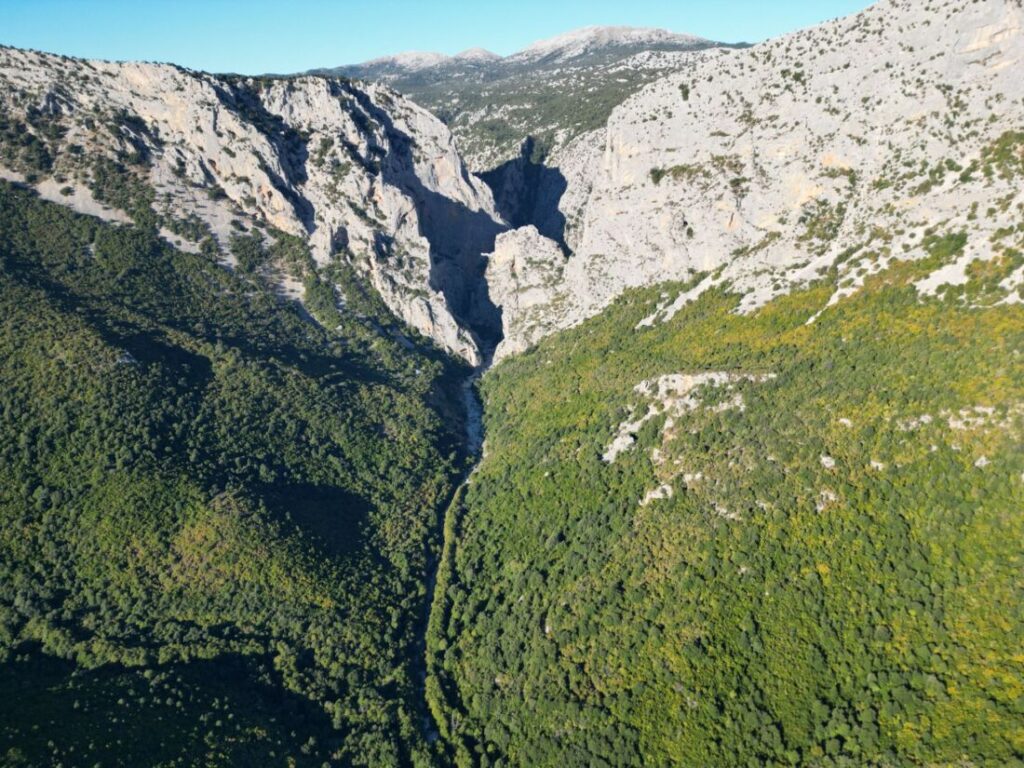
In the Supramonte mountains, between the municipalities of Urzulei and Orgosolo, the Riu Flumineddu river has carved deep into the limestone over thousands of years, creating one of Europe’s deepest and, in places, narrowest gorges.
At its most dramatic point, the walls rise up to 500 meters, while further in, the gorge narrows to just a few meters wide. The Gorropu Gorge is one of the absolute highlights of the Gulf of Orosei – right up there with bays like Cala Luna or Cala Goloritzé.

Don’t miss this Sardinia highlight on your road trip. That said, the Gorropu Gorge is by no means easy to reach – you’ll need to hike for at least 1–2 hours just to get to the entrance of this spectacular canyon. Exactly how to get there and what to watch out for is covered in the next section.
The Hike to the Gorropu Gorge
Two Trailheads – Which Route Should You Choose?
The most important thing to know upfront: there are two completely different ways to reach the gorge, and your choice of trailhead has a big impact on what your hike will be like.


Option #1: Genna Silana Pass – Steeper, But the More Scenic Route
The most commonly used access point starts up on the Genna Silana pass along the SS125. From here, it’s a very steep descent of around 700 meters in elevation down into the valley. The trail is well maintained, but it still takes a toll on your legs.
In return, you get a beautiful view of the valley and the Supramonte mountains the whole way. One upside: there’s no parking fee up here on the pass. The downside is the climb back up – if you don’t want to hike it yourself, you can take a jeep taxi back up for around €18 per person.
The descent is fairly quick at 1–1.5 hours. For the climb back up, plan for roughly double that.
The Jeep Transfer
You can book the jeep transfer (either round trip for €24, or one-way back up for €18) at a small kiosk up at the parking lot. If you hike down into the gorge and only want a ride back up, the meeting point for the jeep transfer is about 2 km from the gorge entrance.
You’ll be picked up there and driven up to the pass road. From there, only one person per group is taken the rest of the way to the pass by minibus. You’ll then need to get into your car and pick up the rest of your group.


Option #2: Ponte Sa Barva Bridge – Flatter, Longer & Less Scenic
The second access route runs via the Ponte Sa Barva bridge, where there’s a paid parking lot. You’ll barely gain any elevation here, but the trail constantly goes slightly up and down over several kilometers, and it’s about 2 km longer overall than the route from the pass.
There’s no scenic panorama on this stretch, but you save yourself almost all of the strenuous elevation gain. This is the route we took on our visit to the gorge. Parking here costs €10 for the day, and there’s no alternative to it. If you also want to stay overnight here with your camper or RV, the total cost is €15.
The hike from Ponte Sa Barva takes about 2 hours each way and is very well signposted – you really can’t get lost. Along the way there are occasional spots to cool off in the river, depending on the water level.
Our Recommendation for Which Trailhead to Choose
If you’re not after a sporting challenge but still want a beautiful hike, we’d recommend Option 1 and taking the jeep transfer back up. You’ll recoup part of that cost anyway, since you won’t have to pay for parking.
The Hike to & Through the Gorge
Whichever trailhead you choose, the last stretch of almost 2 km to the gorge is the same for both hikes. You’ll scramble over rocks and roots through dense forest until you reach the gorge entrance. Here you buy your ticket (€6, cash only) and wait for a short briefing, after which you can explore the gorge on your own.
In spring, the riverbed inside the gorge may be carrying water, which means you won’t be able to see the whole gorge. In summer or fall, though, the river should be dry and won’t get in your way.
One real advantage of hiking through the canyon is its flexibility: everyone can decide for themselves how far into the Gorropu Gorge they want to go. Even the first section offers spectacular views and is manageable for most hikers. As the gorge gets deeper, though, the terrain becomes noticeably more demanding and requires good footing and a bit of scrambling skill.
The gorge is color-coded for this: a green, a yellow and a red zone. Altogether, the section you can actually walk through is only a few hundred meters long – plan for about half an hour to explore it and take photos.
Because the path leads over, under and sometimes directly through the rocks, you’re never moving quickly. You’re constantly figuring out the right way through, while also not forgetting to marvel at the sheer force of nature towering above you.


The green zone probably takes the longest to get through. The yellow zone then narrows further and is marked by a yellow dot painted on a rock. The boulders get bigger here, and since they’re very slippery, they’re not easy to climb.
After a few minutes you’ll reach the red zone, which you’re officially not allowed to enter without a guide. Some people do it anyway, of course. The route here gets very difficult and even dangerous, since you sometimes have to climb boulders several meters high that are, again, very slippery.
Practical Tips for the Gorropu Gorge Hike
Opening Hours & Admission
Admission costs €6 for adults and €4 for children (ages 6–17), paid in cash directly at the info point by the gorge entrance. During our visit in October, last entry was at 3:45 pm and it closed at 4:45 pm. In peak summer, hours can be a bit longer. Either way, you should set off very early. In summer, that means you’ll avoid the midday heat and have the gorge to share with only a few other people.
Which Trailhead Is Easier – Genna Silana or Ponte Sa Barva?
Neither one is really “easy”: from Genna Silana you get around 700 meters of elevation gain over a shorter distance, while from Ponte Sa Barva there’s barely any elevation gain, but almost 2 km more distance and little in the way of views. If you want to save your legs, you can take a jeep taxi from Genna Silana just for the way back (€18 per person).
Is there phone signal in the gorge?
Yes, surprisingly: right in the middle of the narrow gorge, we had surprisingly good 5G signal everywhere.


Can you swim in the Gorropu Gorge?
Not really inside the gorge itself, but depending on the season, the Riu Flumineddu river along the Ponte Sa Barva route carries some water you can cool off in. In spring, the gorge can sometimes be flooded high enough that you won’t be able to reach the yellow zone.
Is the Gorropu Gorge suitable for families?
The green and yellow zones are generally manageable for families, but the approach, which involves several hours of hiking and some steep terrain, is demanding, especially from the Genna Silana pass. For younger kids, the flatter route via Ponte Sa Barva is probably the better choice.
The best way to combine your visit to the Gorropu Gorge in Sardinia is with a stay in Cala Gonone, which is also where the boat tours to the Grotta del Bue Marino and Cala Luna depart from. For the full tour through the south and east of the island, you’ll find everything you need in our 7-day Sardinia road trip.
Are dogs allowed in the Gorropu Gorge?
Yes, that’s absolutely no problem. We had our dog with us too. As long as your four-legged friend can handle the strenuous hike, they’re of course allowed into the gorge as well (at no extra cost).